Fun City Heist by Michael Kardos
/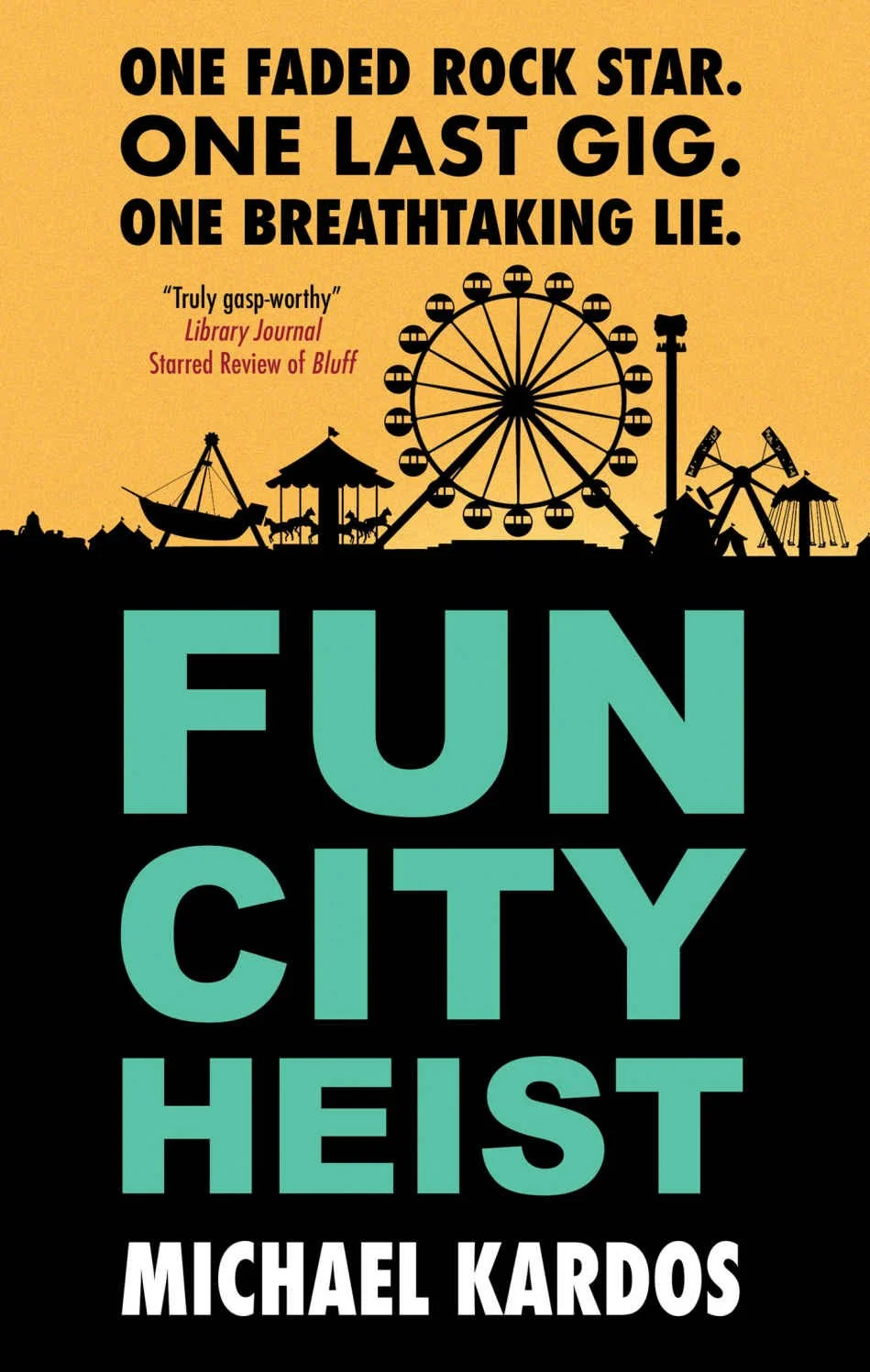
Fun City Heist
by Michael Kardos
Severn House, December 2025
Pushcart Prize-winning author Michael Kardos, ex-professional musician and former co-director of the creative writing program at Mississippi State University, returns with his fourth novel, Fun City Heist, a wry and spry mashup of rock and roll and grand larceny.
Kardos's first-person romp begins on a New Jersey beach with umbrella shack manager and narrator Mo Melnick, ex-drummer of the long-disbanded, almost-famous rock group Sunshine Apocalypse. Seemingly content with an existence of unfulfilling stasis (if that doesn't sound like a Mo Melnick, I don't know what does), Mo's life is sent into a tailspin when Johnny, ex-singer of Sunshine Apocalypse, shows up out of the blue. He wants to reunite the band for a one-off performance at Fun City, the local Coney Island-esque landmark. Ed and Ricky, the OG bassist and guitarist, are already on board. The problem for Mo is, Sunshine Apocalypse's breakup was brutal (what rock band's isn't), and while he is trying to decide whether or not to dredge up that painful past, he's visited by another artifact of that era: his teenage daughter Janice, product of an on-and-off fling with an Apocalypse groupie. Having met Janice a mere handful of times, Mo reluctantly invites the near stranger to move into his apartment for the summer. Shortly after, Johnny reveals that reuniting Sunshine Apocalypse is, in reality, due to an impending financial crisis. He has a terminal illness and end-of-life care is going to cost a fortune. So Mo relents and Sunshine Apocalypse begins to rehearse, until Ricky breaks his arm in a car accident. With no guitarist, the reunion is doomed, but then Janice picks up Ricky's axe.
And Mo thinks . . .
. . . before she plays a single note, I know.
We all do.
We know because a musician knows from watching the way somebody sits with the instrument. I can see a drummer behind the set, sticks in hand, and from the player’s posture, the way the hands hold the sticks, the position of the arms and looseness of the wrists, I’ll know if the musician’s any good. And I’ll know how good. I’m never wrong. I don’t need to hear anything. I can tell from a photograph.
I’m not a guitarist, but it doesn’t matter. Any decent musician can see from the way she’s holding the instrument, from her wrists and hands and fingers, her shoulders, from the parts and from the whole, that Janice undersold herself the other day at my apartment. She can play . . .
One gig, though, isn't going to cover Johnny's hospice care, and so Johnny reveals his full plan. The cash receipts from Fun City's Fourth of July festivities, tucked away in an old safe in an easily accessed basement office, should tally up to thousands. Hundreds of thousands. And that would be enough to see him to the end. Therefore, the band needs to rob Fun City during their upcoming gig. Mo is suddenly forced to decide a few things. Is he going to help his dying bandmate, regardless of the risk? Is he going to allow Janice to be involved? What kind of father is he? Does he even want to be a father?
From here Kardos conducts readers through an aria of Mo's misadventures: musical conquests and clams, dangerous assaults and extortions, budding romances, fragile relationships, personal growth, regression, and more. The oft-thrilling ride concludes with a climax that is as satisfying as it is clever. The whole experience is genuinely entertaining and, as a side note, refreshingly and surprisingly (considering Kardos's CV) devoid of academia or industry agendas. That said, like any performance with a heart, it does skip a beat or two. At times Kardos relies on readers to over-suspend their disbelief, and at times his characters don't foresee some obvious pitfalls, which in both cases could leave readers scratching their heads if they aren't willing to chuckle at these liberties. (This is a cheeky heist yarn, after all.)
Most notably, Fun City Heist is authentic. Remarkably authentic. Mo's narrative voice is truly that of a former rock-and-roll drummer coasting through life renting beach umbrellas. Musical references abound (as one would imagine) and are masterfully executed, as nearly all perform at one level for non-musicians and yet take on whole new level of connection for those who have some experience in music, as seen in the quote above. There, non-musicians should grasp the basic concept simply from the skill of Kardos's description. Veteran instrumentalists, however, will delight in the pure esoteric truth of it. In fact, the novel sings with this kind of scalable authenticity and will put the occasional grin of recognition on the face of any musical dabbler. But if you happen to be an ex-six-stringer of an 80s metal cover band, Fun City Heist will keep you nodding and smiling for days after the last page is turned.
Jim Abbiati is a writer, book reviewer, and IT professional living in Mystic, Connecticut. He's the author of Fell's Hollow, The NORTAV Method for Writers, and has an MFA in Creative Writing from National University