Chosen Land by Matthew Avery Sutton
/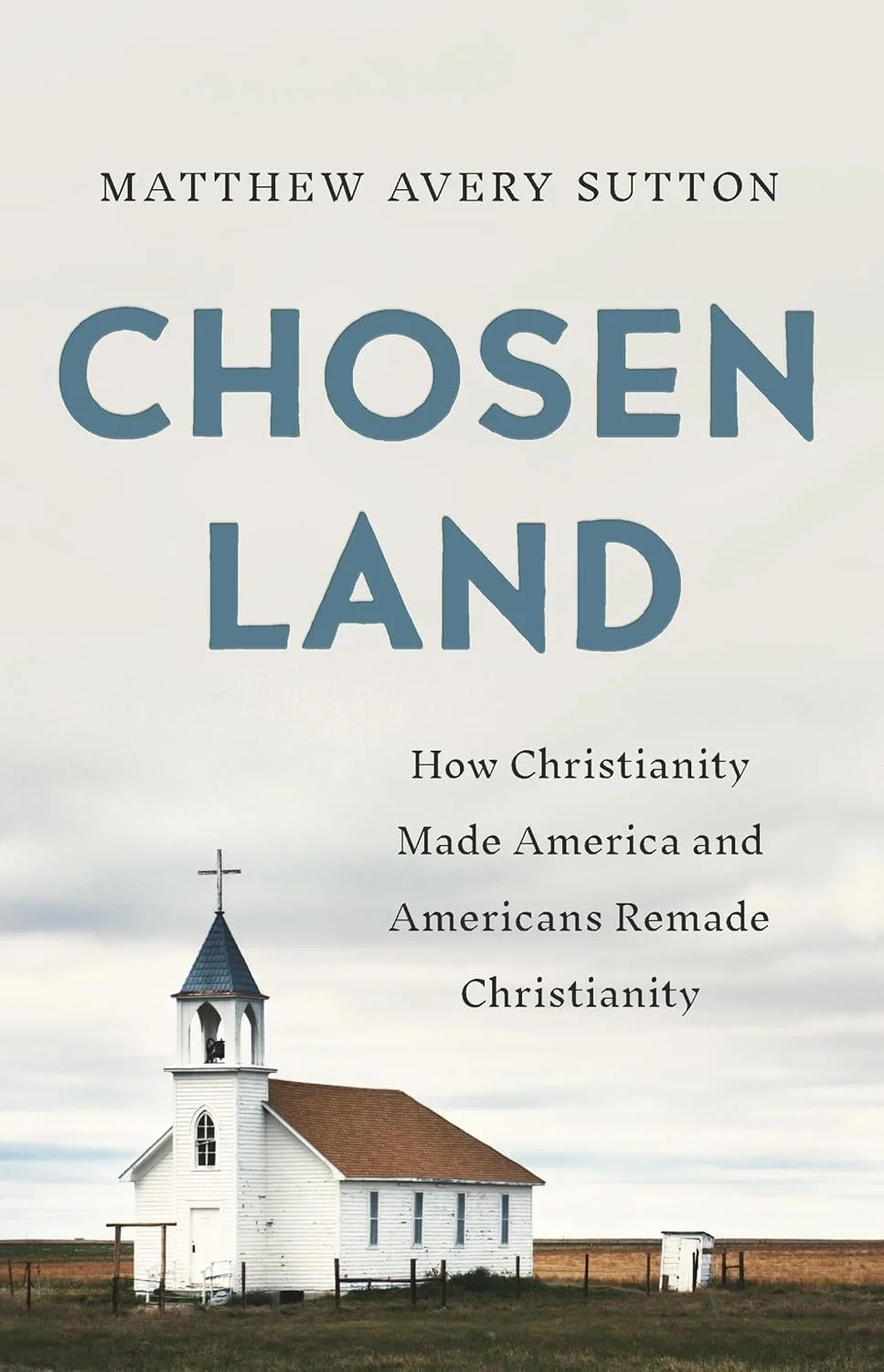
Chosen Land: How Christianity Made America and Americans Remade Christianity
By Matthew Avery Sutton
Basic Books 2026
“We cannot understand the United States without understanding the faith that built it,” writes Washington State University history professor Matthew Avery Sutton in his quietly brilliant new book Chosen Land: How Christianity Made America and Americans Remade Christianity, before follow it up with an observation that can hardly be interpreted otherwise than as a threat: “The past that Christians constructed defines the present for both believers and unbelievers alike.”
In under 600 pages, Sutton somehow manages to chart the birth of Christianity in the New World and its many transformations over the ensuing centuries, all encompassed in a narrative that never feels rushed or cramped, never condescends to its reader, and virtually never slackens in its pace. And Sutton stays true to that initial claim: he must know that the majority of his US readers in 2026 are going to be eager for the contemporary end of his long tale, but he balances his story perfectly, starting with Martin Luther and the Puritans in New England and moving on at in a virtually novelistic sequence of dramatic moments through all the various religious revivals that gripped the country as it was growing and expanding.
He covers it all, from the revivals that shaped the character of colonial America to the crucible of the American Civil War to the story’s true inflection point, the rise of fundamentalism in the wake of the First World War and the increasingly tight welding of Christianity with conservative politics, always in response to the changing electoral landscape – and the changing personal beliefs of the faithful:
Christianity often worked more as an addition to traditional beliefs than a complete replacement. Converts wove Christianity into their existing way of life rather than embarking on an entirely new path. This kind of blending – where different faiths mix and create something new – happened again and again throughout Christian history. Because of ongoing contact, combination, and exchange, Christianity kept evolving over time, always adapting from one generation to the next.
Well past the book’s half-way point, Sutton’s story slips smoothly into the recognizable modern era, when Jerry Falwell “told Christians around the national that they had a threefold mission: to get people saved, to get them baptized, and to get them registered to vote,” and when Oral Roberts and his spiritual progeny began preaching a “prosperity gospel” the explicitly links Christianity to both capitalism and greed. By the time the story arrives at contemporary headlines, an amazingly comprehensive story has been crafted and filled in; it’s an astoundingly assured performance.
As with any book of this size and scope, there are minor shortcomings. Since this book was written in the 21st century, for instance, it has no slaves in it, only “the enslaved” or “enslaved people” according to the rhetorical fad currently ironclad law in academia. As his End Notes make clear, Sutton has consulted a vast body of sources, but inexcusably, the book contains no bibliography. He is very occasionally inaccurate (it was, for example, the Boston Phoenix in 2001, not the Boston Globe in 2002, that broke the story of the Catholic Church’s massive sex scandal) and often exerts himself to Ned Flanders-levels of politeness, as when he unironically refers to alcoholic philandering wife-beating fraudulent embezzler Cyrus Scofield (of the Scofield Reference Bible) was “a bit of a scoundrel.”
But such slips are usually both rare and relatively trivial, overshadowed by Sutton’s unfailing ability to keep his focus on the explosive main elements running through his story. Recurrent throughout his book is the quicksilver, combustible nature of Christianity itself, which could be malleable to the times but could just as often slip out of the control of even its most dedicated manipulators. “Despite enslavers’ best efforts, they could not control the way Black North Americans interpreted and practiced Christianity,” he writes, referring to Christianity as practiced by slaves. “As the Romans recognized in the first century, Christianity could inspire revolution.”
The nature of the present revolution has overtones Sutton is too polite and perhaps too optimistic to underscore. “When Donald Trump returned to the White House in January 2025,” he notes in closing, “he did so not just as a politician, but as a self-anointed messiah.” If that’s a culmination, it’s the most disturbing one in Sutton’s entire book, saved up for last. But in any case, no American Christian or student of American Christianity should miss this book.
Steve Donoghue is a founding editor of Open Letters Monthly. His book criticism has appeared in The Washington Post, The American Conservative, The Spectator, The Wall Street Journal, The National, and the Daily Star. He has written regularly for The Boston Globe, the Vineyard Gazette, and the Christian Science Monitor and is the Books editor of Georgia’s Big Canoe News