Cromwell's Spy by Dennis Sewell
/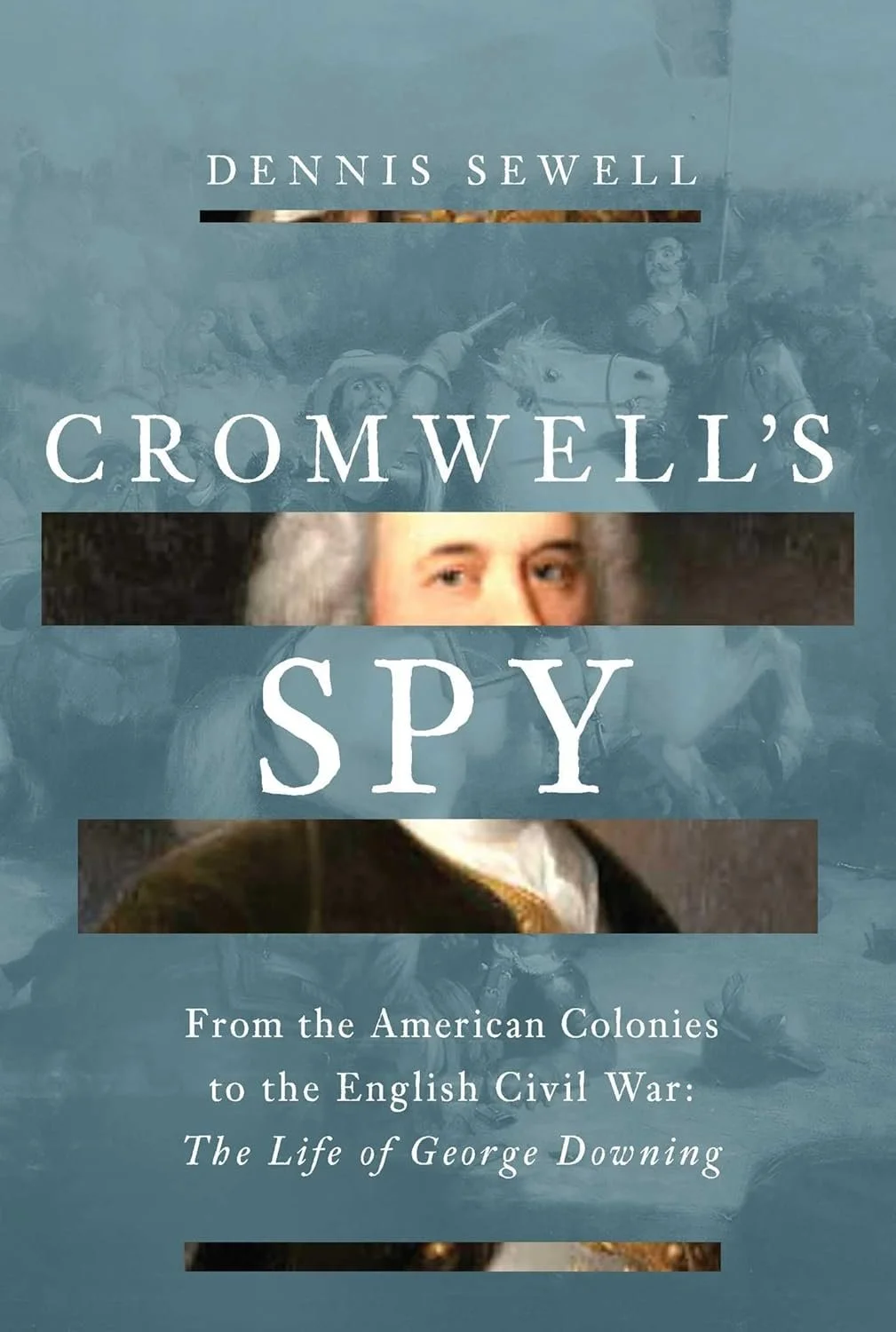
Cromwell’s Spy: From the American Colonies to the English Civil War: The Life of George Downing
By Dennis Sewell
Pegasus Books 2026
“This book will not advance any contrarian or revisionist line,” writes two-decade BBC News veteran Dennis Sewell in his new biography of Restoration slime-beast George Downing. “Rather, it accepts him as he was: a man who betrayed his former friends and colleagues; not to save his own skin, either, but to further his career.”
Downing’s countless betrayals, endless iniquities, and bottomless greed were all well-known in his own day, although now, centuries later, his name is only known for the row of buildings he had built on the cheap in 1682 and that now, perhaps fittingly, houses the UK government (“who names a street after himself?” exclaims Sewell with refreshing incredulity). He was Scoutmaster-General to Oliver Cromwell’s Scottish army, married the sister of one of Cromwell’s major-generals, and as Teller of the Receipt at the Exchequer was, among other things, the boss of Samuel Pepys, who tried and failed to like the man even while appreciating the drive of his leadership. Pepys also marveled at the man’s greed for money, which, considering the source, gives a fairly clear idea of how great that greed was (referring to men like Downing, Pepys in 1665 sneered at what he called “these great dealers in everything”).
Downing had a deep connection to the New World too; he was the nephew of the Governor of Massachusetts, and he graduated second in the first class at Harvard. The school, Sewell notes, “was founded by Puritans in the pious hope that it would turn out saints, but in George Downing it apparently summoned a demon.” And on both continents, and through decades of first supporting Cromwell’s treachery against King Charles and then supporting the hunt for all of his former Cromwellian colleagues, he reveled in pure clear-eyed self-interest. As Sewell mentions, Downing learned a crucial lesson from crusty old General Monck early in his professional career: “one can swap sides and yet prosper.”
Sewell sets his book against what he views as an odd pall of silence that’s fallen over Downing’s name. Biographers and historians, he contends, tend to hustle him down into the footnotes. “Scour the indexes of Civil War histories,” he writes, “and Downing rates a scant mention.” And sure enough, he’s mentioned only in passing in Antonia Fraser’s huge bestselling biography of Cromwell, even though Downing and Cromwell were cheek-to-jowl for years.
And in all that time, Downing “was exposed, by the example of his colleagues, to a variety of enticing schemes for self-enrichment, and the moral climate of his times and profession was apparently indulgent towards a little gentle peculation here and there.” Sewell follows him in detail mainly through these peculation periods of his life; as indicated by its title, Cromwell’s Spy isn’t really a full-dress biography of the man, although it leaves out little of substance even so. And Sewell makes the whole of it lively, riveting reading, full of offhand literacy and playful allusions that would have sailed right over Downing’s head but make for mighty enjoyable reading.
The expectation hovering over all of it is that the opening contention, that this isn’t a revisionist take, will somehow be disowned, that this will even so end up being some kind of reclamation of one of the most repulsive figures in the last 500 years. The 21st century publishing world seems to love such reclamations, and even at the two-thirds point of Cromwell’s Spy some readers will doubtless be expecting the grand “…and yet.”
But it never happens, much to Sewell’s credit. “It would be wrong to portray Downing as some kind of sly-yet-endearing rogue with a brazen front and a taste for black humour, a plump metropolitan Autolycus,” he writes. “His hands were forever stained with blood.” It’s tough to make such an entertaining book about such a worthless figure, but Sewell somehow manages it.
Steve Donoghue is a founding editor of Open Letters Monthly. His book criticism has appeared in The Washington Post, The American Conservative, The Spectator, The Wall Street Journal, The National, and the Daily Star. He has written regularly for The Boston Globe, the Vineyard Gazette, and the Christian Science Monitor and is the Books editor of Georgia’s Big Canoe News