Crawlspace by Adam Christopher
/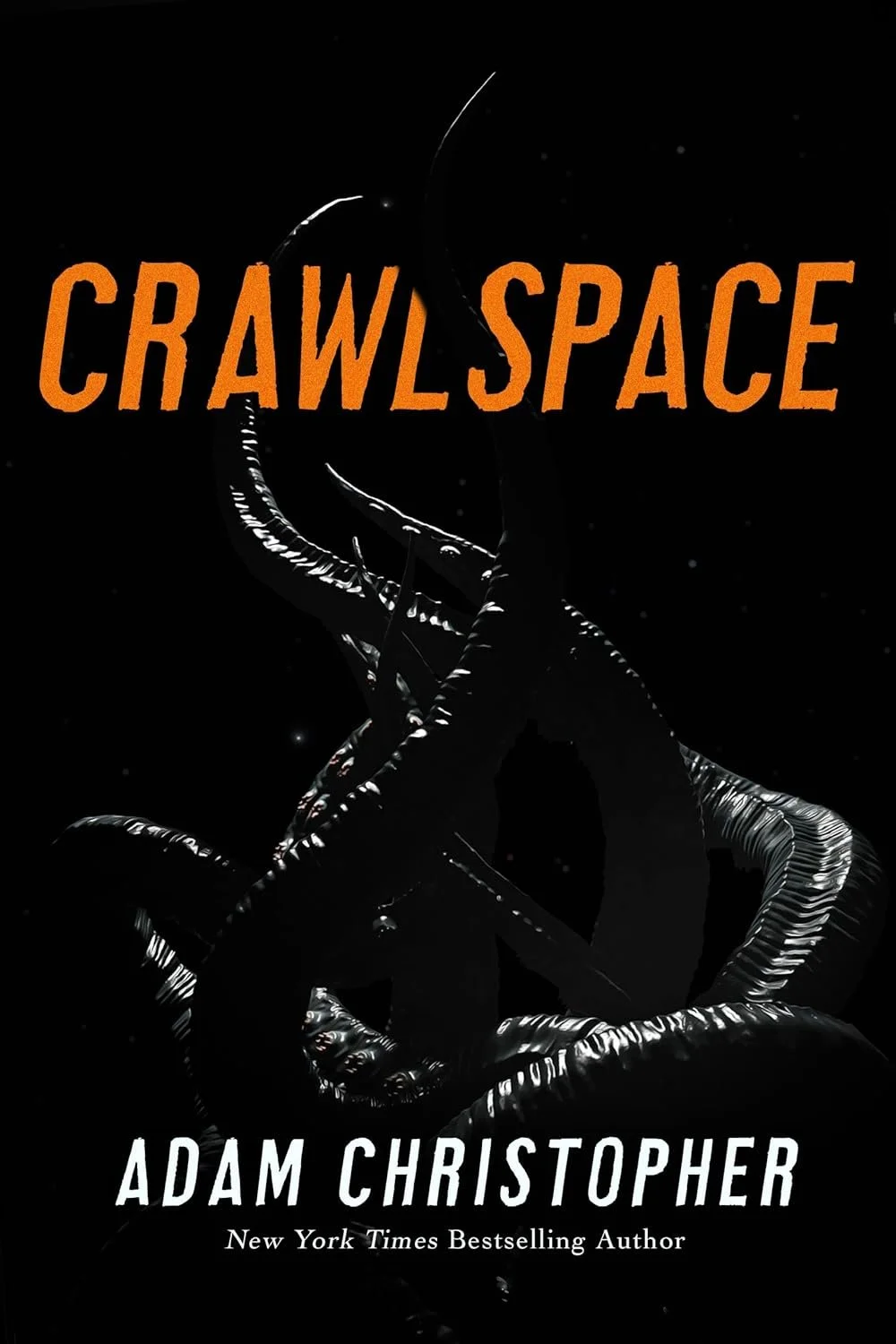
Crawlspace
by Adam Christopher
Tor Nightfire, March 2026
Adam Christopher is a well-established science fiction author known for producing both original and franchise tie-in work. His 2012 debut novel, Empire State, was lauded as a Book of the Year by SciFi Now and the Financial Times. He's written for well-known properties such as Star Wars, Stranger Things, Doctor Who, and World of Warcraft. His latest book, Crawlspace, fits nicely within his growing original oeuvre, but it does veer decidedly into Lovecraftian territory. Think Alien meets The Call of Cthulhu skillfully balanced between slow-burn and breakneck speeds and you'll have some idea what to expect.
Christopher opens his new sci-fi/thriller with the space station launch of XK72, the latest interstellar ship developed by the Artemis Corporation. Its mission: test a prototype hyperspace drive called SLIP with a millisecond jump designed to load several massive storage banks with test data. Christopher spends the first four chapters leading up to the launch, growing tension as he introduces his cast of characters: mission lead Liv Halliday, engineers Astrid Healey and Avery Cormack, data specialist Mirai Ikeda, jack-of-all-trades Titus "Deak" Deacon, and the newly assigned pilot Colonel Redway. He builds this pre-launch suspense until:
“Nine . . .”
As the final countdown started, the crew began calling in their own reports. It was overkill perhaps, given everything was now more or less running on automatic, the ship’s passive (or “dumb”, Deacon liked to call it, perhaps with a little too much enthusiasm) mainframe computer handling almost everything, save for the Drop itself, controlled by a switch Redway had the honor of throwing. But it was all part of the program, the verbal acknowledgments recorded in synch with the system output in Mirai’s Data Monitoring station. It helped with compiling the project report for when all this was over. And if anything went wrong, it was good to have as much data as possible to scrutinize. There wasn’t a black box as such, but everything was logged and recorded.
Avery: “SLIP drive primed.”
“Eight . . .”
Astrid: “Induction power combs at eighty-four percent, charge steady.”
“Seven . . .”
Liv’s eyes flew over the HUD. Everything was looking good. “All systems green.”
“Six . . .”
Mirai: “Data recording.”
“Five . . .”
“Power combs eighty-nine percent.”
“Four . . .”
“Power combs ninety-three percent.”
“Three . . .”
“Power combs ninety-eight percent. SLIP drive engaged.”
“Two . . .”
Beyond Liv’s HUD, the half-shaded disc of the earth looked close enough to reach out and take. It pulled at Liv’s gaze, and she found herself suddenly, desperately, terribly homesick. The feeling caught her by surprise, as did the fluttering feeling inside her chest.
“SLIP drive ignition.”
It was fine. Everything was fine. This was just part of the project. They would Drop, fill every exabyte of data storage they had onboard, then return home. Return to that thing, that small ball floating in the deep nothing in front of the window.
“One . . .”
From here Crawlspace splits in two. The main story leaps into sci-fi/thriller overdrive as the cast is forced to battle time (and other unmentionables) to avoid disaster. Christopher, like every skilled thriller writer, ends each scene with the cast failing, failing while things get worse, or succeeding—only to discover an even bigger problem has cropped up. There's no rest for the wicked or the good or the reader. Woven through this hurtling adventure is a creepiness, a psychological horror element that lurks in the background, becoming more and more noticeable, until it morphs into full-blown, in-your-face terror by the end. The juxtaposition of these pacings, a slow-growing infection affecting the fast-moving action, gives Crawlspace an eerie, unsettled atmosphere that's delightfully disturbing.
Christopher's prose work is clean and unaffected; it gets the job done and doesn't get in the way. His cast of characters is varied, each quirky in their own way, and relatable. Some might be less developed than others, but none feel like cardboard cutouts. His forays into science and technology can get a little tricky, but comprehension isn't a prerequisite to following or enjoying the story. That said, Crawlspace does have a few cracks in its shielding.
While the thriller-esque mechanics of the story are generally well executed, they can at times be overdone, to the point where the author's scaffolding peeks through, leading to several "I see what you're doing there" moments. Worse, the thriller-esque mechanics give way to an ambiguous ending more typical of a straightforward psychological horror tale, which feels disappointing in this case. Worst of all, a large portion of the horror element's climax is played out off-camera and is probably the only major defect in the story.
These stumbles aside, Crawlspace is well worth the ride . . . just make sure you're buckled up when it lands.
Jim Abbiati is a writer, book reviewer, and IT professional living in Mystic, Connecticut. He's the author of Fell's Hollow, The NORTAV Method for Writers, and has an MFA in Creative Writing from National University