Margaret Beaufort by Lauren Johnson
/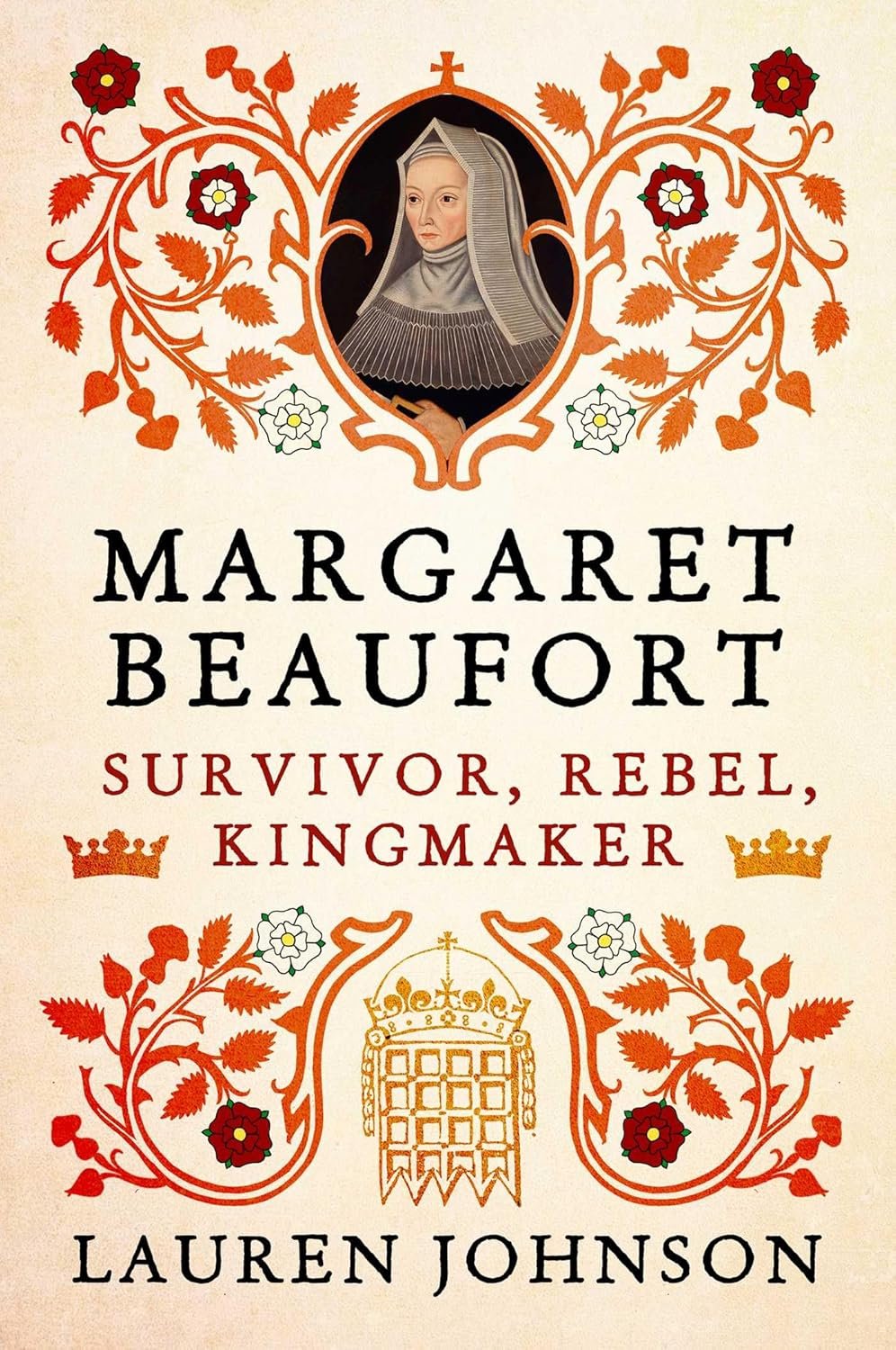
Margaret Beaufort: Survivor, Rebel, Kingmaker
By Lauren Johnson
Pegasus Books 2026
Henry Tudor won the English crown by defeating Richard III at the Battle of Bosworth; his accession ended the Wars of the Roses and launched the Early Modern Era. That is the simplistic view of the story. Far more interesting is the story of Henry’s mother, Margaret Beaufort, who sets the stage for Henry’s path to the throne, watches from the wings during his reign, and shuts the theater lights after it ends. Historical fiction has loved to portray her as a cold, scheming witch and the mother-in-law from hell. Much of this comes from early interpretations based on warped views of women and religion, which Lauren Johnson careful refutes in her new book Margaret Beaufort: Survivor, Rebel, Kingmaker.
Born with a royal claim and fortune as daughter and sole heiress of John, Duke of Somerset, Margaret was thrust into conflict before her first birthday, when her father’s death made her a ward of the court – a pawn. At the age of seven, she was given in marriage to John de la Pole, a Yorkist, though the marriage was annulled before she left her mother’s home. At the age of twelve, King Henry VI had her marry his half-brother, Edmund Tudor, a Lancastrian. The barely pubescent Margaret was immediately sent to live in her husband’s estates in the Welsh territories, separated from everyone and everything she had known. In rapid succession, she was impregnated, widowed, and endured a difficult birth that likely did her permanent physical injury. With her son’s wardship awarded to her husband’s brother Jasper Tudor, she left for the political safety of a third marriage: Sir Henry Stafford, the second son of the Duke of Buckingham, and another Lancastrian.
This marriage was by all accounts a happy one, the partnership successfully navigating through the dangerous waters as the throne changed from Henry VI to Edward IV and back to Henry. Margaret was not as lucky when Edward IV grabbed the throne back: Stafford died in battle and Margaret’s properties were awarded to Edward’s brother. Once again, remarriage offered safety: this time in Thomas Stanley, a Yorkist, who with the byzantine twists of the Wars of the Roses actually ended up awarded Margaret’s properties. Still, the main theme of this period of Margaret’s life is that her shifting alliances were often too late or too early. “Margaret is justly celebrated as a capable political operator,” Johnson writes, “but what struck me in telling her story in this way is how seldom she acted with any clear political allegiance – despite her reputation as a ‘Lancastrian’ – and how often, in the first forty years of her life, she got things wrong.”
All of which changed when her son carried the day at Bosworth Field. Then, Margaret had to carve for herself a special role as the first king’s mother that was not a queen dowager. The new Henry VII was happy to invest her with quasi-royal powers, such as serving as his regent in the midlands where her extensive estates gave her – and him – power. And this time they were fully her own estates: on Henry’s accession she was designated a femme sole, giving her financial independence from Stanley; this was extended to full independence when Margaret became a vowess, taking a formal vow of chastity before a bishop in order to untangle herself from the Stanley family without creating rancor. Her commitment to religious devotion did not shield her from involvement at court: with pretenders threatening the Tudor rule, with the deaths of Arthur Tudor and then Elizabeth of York, with Henry himself weakening, Margaret’s steady influence only grew. And in the end, while forced to bury her son, we also see her comforted by her grandson’s smooth accession and the security to the dynasty represented by his Spanish wife.
Although the book inevitably is structured around Henry’s path to the throne and reign, the story is all Margaret’s. Johnson’s writing is crisp and evocative, and she captures moments with a poet’s skill. Speaking of Henry’s coronation:
Through the clouds of incense, Margaret might have been able to make out the glimmering stalls of goldsmiths and the silver crosses and censers of priests, their metalwork catching the sunlight as they swung between shafts of light and shadow. It was a bright morning, but clouds overhead threatened rain. With her ingrained pessimism, perhaps Margaret awaited the downfall with more certainty than her companion that day, her thirteen-year-old granddaughter Princess Mary
Still, the book’s most exciting feature is Johnson’s extensive use of financial records (grants, wills, inventories, and especially household accounts) to mold an insightful understanding of her subject. Margaret’s expenses substantiated her social network: visits to court and others were documented through payments for bread and ale in taverns where she broke her journey, and her sphere of influence (or attempted influence) is measured in the gifts she sent and their value. These details also substantiate the importance she placed on disseminating learning (she commissioned the publication of numerous works, 500-100 volumes at a time, distributing them to people she knew) and loyalty (she insisted that a good portion of the scholarships she established at Cambridge be directed at students in the north). Johnson even teases out Margaret’s sense of humor and appreciation of puns (not as difficult as this may seem: Margaret is marguerite in French, so daisies and forget-me-nots make frequent appearances).
There have been other biographies of Margaret Beaufort, but Lauren Johnson comes at her subject through a specialization in the fifteenth and early sixteenth centuries and gets to the heart of the convoluted developments in the Wars of the Roses without allowing the historical complexity to overwhelm the reader. Even more distinctive, Johnson successfully teases out the one element that “has been consistently missing from Margaret’s story: her womanhood. Not just her status as a woman, but her place in a network of women that extended across generations, counties, and ultimately international borders.” This gives this work tremendous weight, cementing it as a must-read narrative of the era.
Janet Wertman is the author of the Seymour Saga trilogy. Her latest work of Tudor historical fiction is “Nothing Proved,” the first installment in her Regina trilogy.