Medium Rare by Natasha Joukovsky
/
Medium Rare
By A. Natasha Joukovsky
Melville House, 2026
Arun Patil of Daedalus Industries has pledged a billion dollars to anyone who can accomplish a near statistical impossibility: correctly pick the winner of every game in the National Collegiate Athletic Association’s (NCAA) “March Madness” men’s college basketball tournament. The best sixty-four college basketball programs in the country receive an invitation to “The Big Dance” each year and face off in a single elimination tournament. Sixty-four schools are reduced to thirty-two, to the “Sweet Sixteen”, “Elite Eight”, and “Final Four”, until a champion is crowned. Yes, those phrases are owned and copyrighted by the NCAA, games are all nationally televised and men plan vasectomies around the schedule so they can lie on the couch for days of guilt-free viewing.
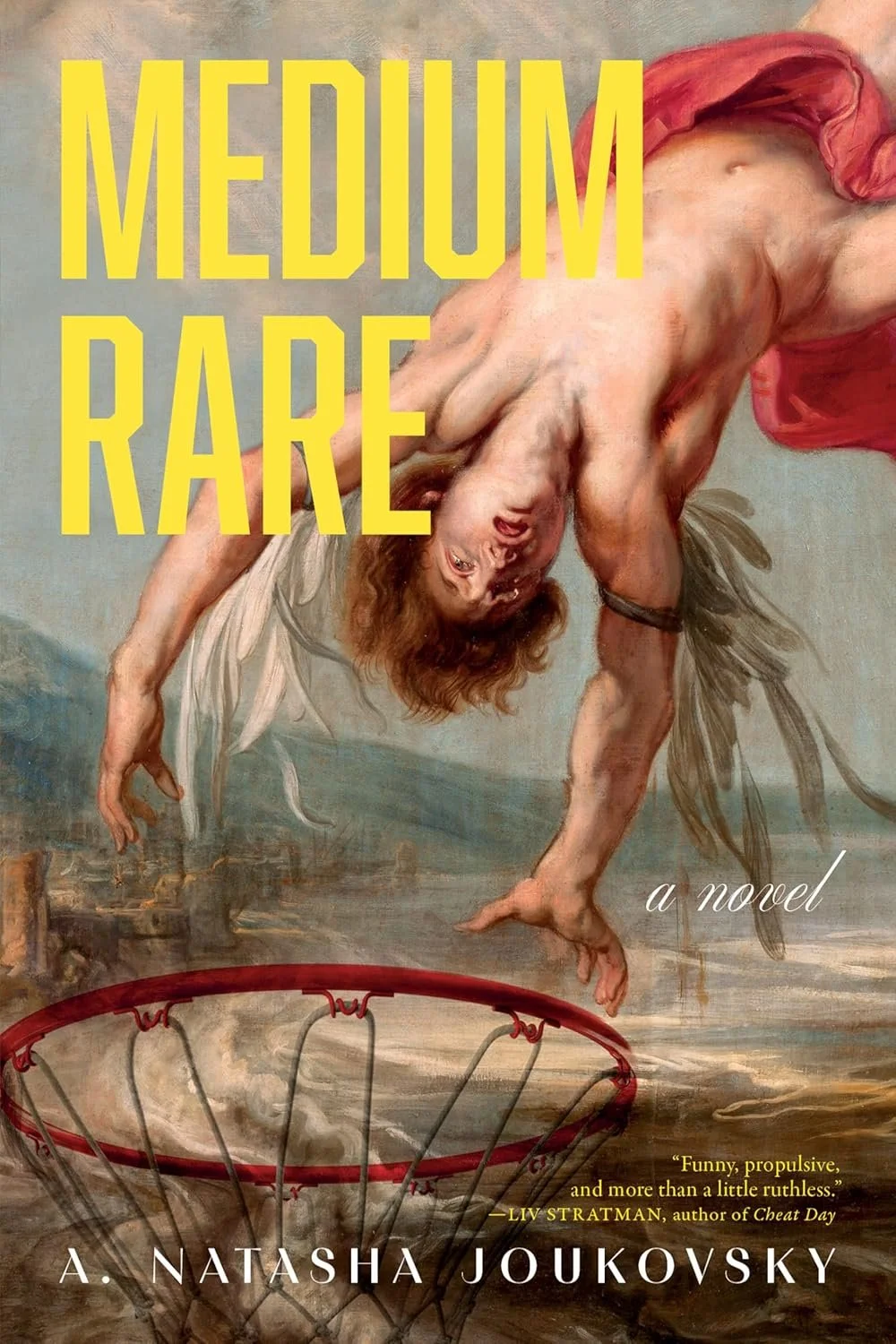
You can care nothing for sports and Medium Rare will riotously entertain. It is a tragicomedy based on the myth of Icarus, using the famed basketball tournament, D.C. politics, and even Hollywood as a brilliant framework for a meteoric journey that highlights the absurdity of power and ambition in America.
Cassandra, a Washington D.C. fundraiser, narrates. Her omniscient first-person telling of the story is truly all-knowing, for she is a modern-day oracle. She’s not the only character in the story with incredible predictive ability, for Phil Fayeton, an ‘everyman’ if there ever was one, does indeed beat infinitesimal odds and selects the near-impossible ‘perfect bracket’. Our author highlights the improbability with smart wordplay:
The odds of filling out a perfect March Madness bracket are so infinitesimal statisticians disagree about just how infinitesimal they are. That’s two to the sixty-third power, mathematically speaking, Phil would explain rattling off each digit with memorial pride. After his first few public appearances, he googled a series of analogies to help contextualize a number of that size, as if to improve its marketability. Pick a grain of sand from anywhere in the world, he’d say, and you’d be twenty-three percent more likely to find it again at random than to fill out a perfect March Madness bracket.
Each round of the tournament serves as its own chapter for the first half of the novel, progressing with the tournament. We are with Phil as he watches the University of Virginia (his alma mater and selected winner) play each game and prose every bit as suspenseful as Laura Hillenbrand’s accounts of Seabiscuit sprinting against War Admiral grips the reader. At each stage, Phil’s correct selection of every game makes him more famous, for his is the rare medium in Medium Rare. By the time Phil is one of thirteen left in the country with all perfect picks, he’s gone from notable among friends and family, to doing podcasts and Skype interviews about basketball. He’s given a Buick, tickets to watch games in premier box seats and rapidly becomes a “personal interest story” for national television networks. Upon holding the only remaining perfect bracket, he’s a topic of water cooler talk across the nation. We gain insight into his mindset as he verbally spars with billionaire Patil, who only ever sought free publicity. Phil, and wife, Raleigh, watch a game together in the DaedaDome, one that has gone into overtime:
Arun barreled into the owner’s suite, “I will give you a million dollars right now to call off the bet. He regretted this offer the moment it escaped his lips. Phil, rising to his full height, smiled down at him, almost with a look of pity.
“I don’t think so, man,” said Phil.
“Phil,” said Raleigh, implicitly urging him to consider it.
“No, babe, Auburn’s gonna win.”
“There are other games left,” said Arun, appealing now more to Raleigh, and feeling the need, in having made the mistake, to convince himself it hadn’t been one by doubling down. “Ten million.”
“No,” said Phil, more emphatically this time, almost unthinkingly, as Auburn drove in for a layup.
Arun bided his time, until Kentucky again got within three. There were thirteen seconds left. “Offer stands,” he said quietly.
“Phil,” Raleigh whispered to him. Ten million dol—
But the game was over, Auburn had prevailed.
The second half of the novel spotlights Phil outshining senators he once couldn’t even get a meeting with, and chronicles how he handles and mishandles the incredible fame gained as a prognosticator. He soars as high as B-list stardom in Los Angeles, his journey a sensational one, capped off by a wonderfully crafted tailspin. Medium Rare features fresh pieces to the myth and feels original in flavor. The relationship between Phil’s pregnant wife from the Deep South, Raleigh, and narrator Cassandra, is especially poignant. Their friendship evolves from the side-plot to center stage with clever literary maneuvers as Phil stumbles from the summit. This is a book flawlessly placed in modern times.
Joukovsky’s previous novel, Portrait of A Mirror, used innovative flair to recount the myth of Narcissus, and she certainly has a knack for this type of storytelling. Medium Rare will appeal to sports and mythology lovers, while also interest readers who enjoy satirical politics and celebrity. You’ll have trouble not consuming the first half in a single sitting and, a trait increasingly uncommon in contemporary literature, enjoy experiencing characters grow and learn. Characters realize early judgments are misplaced, they are corrected in interesting ways, and we are rewarded with a slam dunk of a finale on a classic tale.
Ryan Davison, Ph.D., is a writer and literary critic residing in Portugal and the U.S.