Nothing Random by Gayle Feldman
/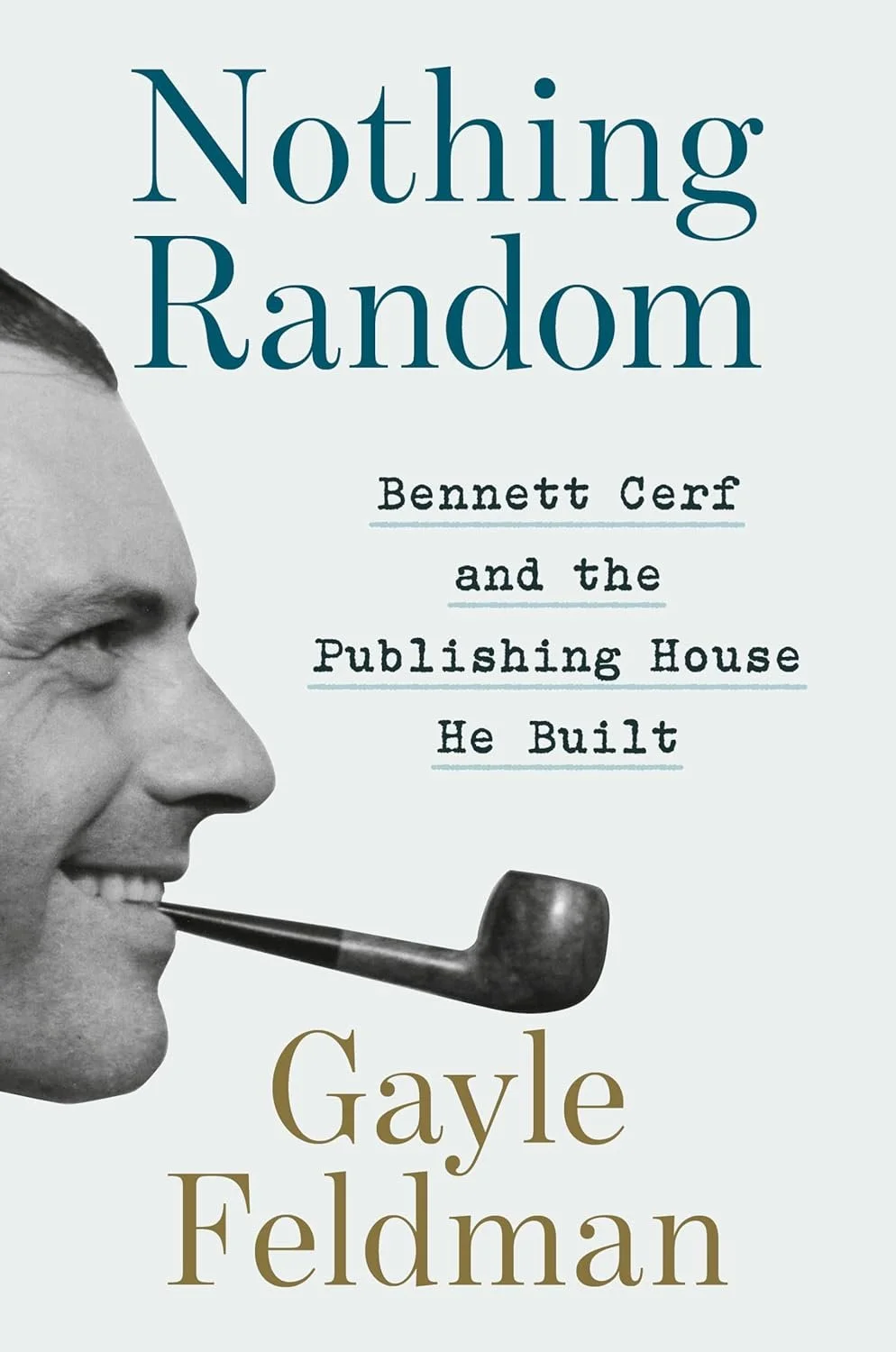
Nothing Random: Bennett Cerf and the Publishing House He Built
By Gayle Feldman
Random House 2026
For much of the twentieth century, Americans encountered publisher Benoît “Bennett” Cerf multiple times a week. Even those who missed his newspaper and magazine columns and radio appearances and Sunday-night gig on TV’s What’s My Line? would find his countenance beaming from multiple covers on their drugstore’s paperback rack. After his death, Random House cobbled together excerpts from Cerf’s written and audio reflections to create the uneven, entertaining memoir At Random (1977). But the company accepted their co-founder’s assertions as fact, while some of the people mentioned begged to differ.
Nearly half a century later, Gayle Feldman has completed a thorough, truthful combination biography–business history that was twenty-four years in the making. Nothing Random delves deeply into Bennett Cerf, Random House, and the collection at the company’s heart, the Modern Library. The author uses corporate and tax records to document the house’s early acquisition of Boni & Liveright and the contemporaneous rises of Alfred A. Knopf and Simon & Schuster. She provides new insight into Cerf’s brief, failed marriage to Hollywood star Sylvia Sidney. She examines this talented overachiever’s self-consciousness over being “Phi Beta Kappa, but also a joke peddler.” She details the roles played in Random House’s success by Cerf’s second wife, radio writer/movie ingenue Phyllis Fraser; his college friend and co-founder, Donald Klopfer; and scores of other people and companies. The lengthy list of dramatis personae in the front matter may seem unnecessary, but as the book inches from the 1920s toward the present day, it proves a helpful resource.
Nothing Random is structured in chronological order, with each chapter focusing on one or two of the authors who made Random House a powerhouse. Feldman makes a point of comparing each writer’s personality, family life, and work habits with Cerf’s, as when she notes that playwright Moss Hart:
could be acidly cutting, and Bennett had a thin skin. Bennett fled introspection, whereas for years Moss had been in analysis, preoccupied by his demons, and could slide into paralyzing depressions. That Moss had described Bennett to The New Yorker … as having “no self-doubt” and as “God’s happy man” wasn’t surprising, given that the insecurities Bennett revealed to [a family friend] he’d never show to Moss; nor did Moss look deeply enough to perceive them. But their shared traits counted for more: the drive to be someone and accomplish great things; an appetite for the work that would get them there, work that flowed into play; and a love for, and dedication to, the story—whether in trimming and recasting their own lives, or in the calling each pursued.
Over five decades, Cerf and Klopfer signed legendary authors and one-book wonders and kicked themselves over a few who got away. Although skeptical at first, Gertrude Stein was an early recruit and would become a lifelong friend. It was a greater struggle to acquire Eugene O’Neill and William Faulkner, figures of immense talent who seemed bent on self-destruction. Some Random House finds demonstrated both talent and charm (Truman Capote, Ralph Ellison, James Michener); others (John O’Hara, William Saroyan) scored higher on talent. The company stood up in court for James Joyce’s earthy novel Ulysses, first for the right to transport it into the United States and then for the right to publish it. (The judge’s ruling: that while “in many places the effect … on the reader undoubtedly is somewhat emetic, nowhere does it tend to be an aphrodisiac.”) The partners watched with amazement as Ayn Rand’s influence ballooned out of all proportion to her work. They dealt with endless connivances by authors, authors’ spouses, agents, fellow publishers, and critics. In some cases, they were the connivers.
Feldman gives particular scrutiny to the fraught relationships between Bennett and Phyllis Cerf and another literary couple, Ted and Helen Palmer Geisel. Ted had published his initial “Dr. Seuss” books with other houses. But, once signed with Random House, he blossomed from the advertising cartoonist most Americans knew into the nation’s most influential writer for very young children. Phyllis and the Geisels labored together to create the Beginner Books imprint, which continues to promote early literacy one syllable at a time. But Bennett resented their control of a part of his company and worked behind his wife’s back to frustrate their more ambitious plans.
Author Gayle Feldman is the former book news editor at Publisher’s Weekly and the U.S. correspondent for the British trade magazine The Bookseller. After contracting to write Nothing Random in 2002 she scoured both archived and in-house company records and the memoirs of major and marginal players. She listened to the full Bennett Cerf audio history tapes. She interviewed the Cerf sons and Klopfer’s daughter and corresponded with Random House sales reps, copy chiefs, and other employees dating back to the firm’s early years. Her research is all but impeccable. So was the uncorrected proof read for this review, a tribute to its author’s editorial expertise. The few imperfections were minor—just three or four typos in more than a thousand pages and a few purple passages—and will likely be addressed by the copyeditor. One anecdote needs to be reworked, wherein a well-known author hired by Random House to write a news figure’s biography verified all the details with law enforcement and government officials, only for his subject’s story to be revealed as a fraud once the book was in print. This is never explained.
As Feldman writes of Bennett Cerf and Random House, “No publishing house, before or since, could be so instantly identified, so publicly, with one man.” In Nothing Random, she has most certainly done justice to them both.
Katherine Harper is an independent editor, mainly of nonfiction works for university and academic presses. Learn more at http://www.kharpereditor.com.