Son of Nobody by Yann Martel
/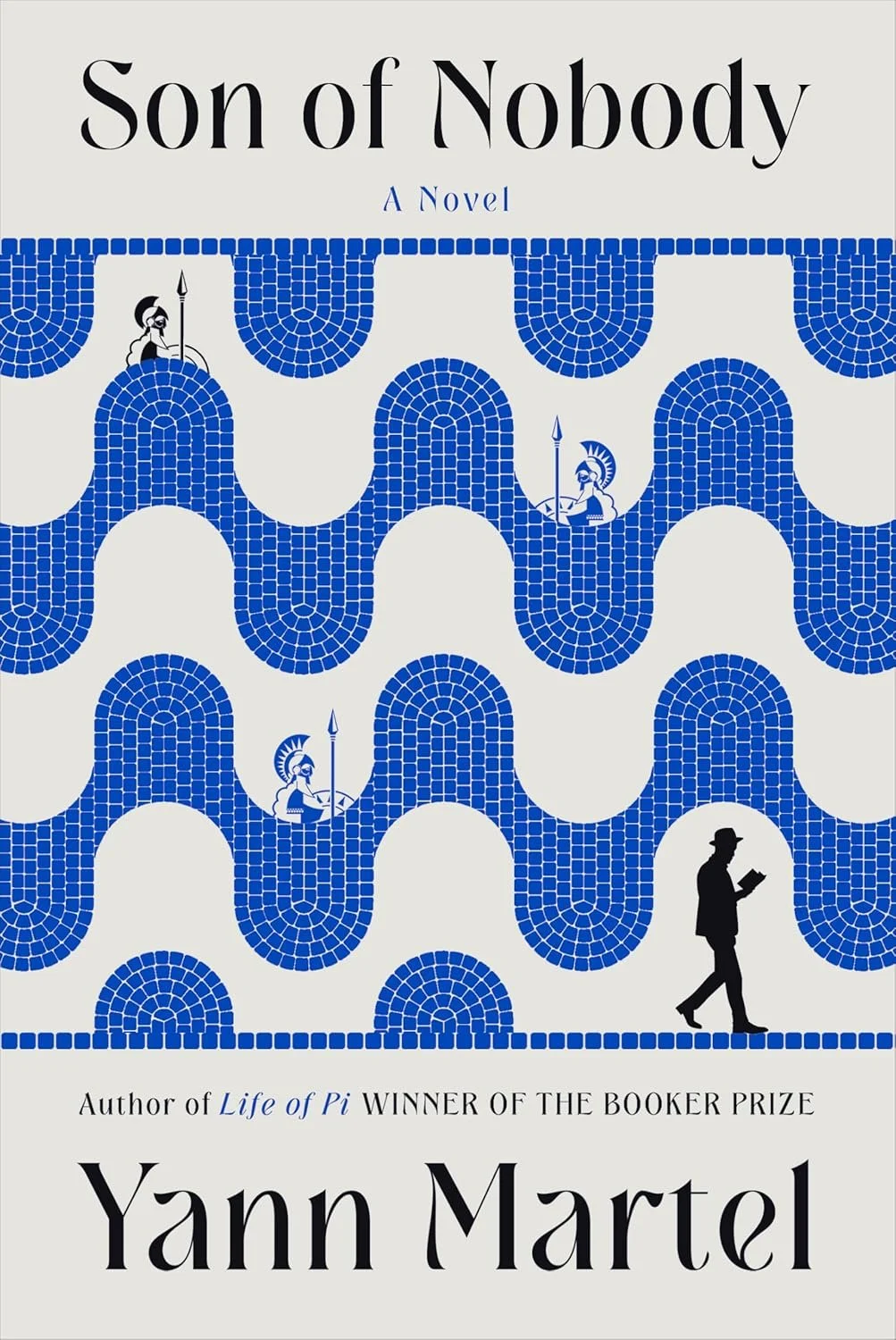
Son of Nobody
by Yann Martel
WW Norton 2026
In Life of Pi, Yann Martel’s bestseller and surprise (to me) Booker winner, the castaway protagonist/narrator, after weeks in a lifeboat with a tiger, wishes he had a Bible or some other scripture to read, but failing that, he says, “At the very least, if I had had a good novel.” Son of Nobody is a “good novel” that would have given the bored Pi much to do: read and re-read, compare his situation with that of Martel’s new desperately marooned protagonist/narrator, try to sort out the novel’s layers of fact and fiction, and learn a great deal about the Trojan war and ancient Greek language.
Scrabbling Canadian classics scholar Harlow Donne wins a prestigious year-long scholarship at Oxford University. His seven-year-old daughter Helen wants him not to leave; his wife tells him not to come back. Although Donne has little money and no friends at Oxford, he soon has a metaphoric tiger by the tail: among the famed libraries’ shards and scripts, he finds fragments of a Greek manuscript that seems to offer an astonishing alternative to Homer’s aristocracy-focused Iliad—a version about a common soldier, Psoas, told, perhaps, by a fellow soldier who, again “perhaps,” may be Thersites, a minor but unique character found in Book II of the Iliad.
Like Life of Pi, where Martel refers to other castaway stories, Son of Nobody employs an old subgenre: the lost and discovered manuscript. There’s a surfeit of such books. Probably the best known are Don Quixote and The Scarlet Letter, but the one closest to Martel’s is less known—Nabokov’s Pale Fire. It is composed of a long poem and even longer commentary by a disturbed academic who imagines himself the escaped King of Zembla. Martel frames his novel as a Ph.D. dissertation with the Greek manuscript in Donne’s translation occupying the top half of the pages, his footnotes on the bottom half.
Initially, the poem appears only as brief fragments, and the notes are mostly scholarly. As the book proceeds, though, the poem appears in long continuous passages (unlikely given the sources), and the notes become obsessively personal, even more unlikely in a dissertation. This information is not a spoiler, for several reasons: the novel’s drift into unreliability is similar to that in Life of Pi and in Pale Fire. But even readers not familiar with those two books will, I think, sense something is off in the late stages of both poem and commentary. The diction of the poem becomes oddly contemporary:”Why can’t we all just get along.” The commentary compares at unnecessary length a crazed Psoas to soldiers in Vietnam. By the end of Son of Nobody readers may feel they need to re-read—like my Pi in his lifeboat—to investigate the novel’s inconsistencies.
I have long been an admirer of Homer’s ugly weakling and contrarian Thersites who has the temerity to criticize the nobleman Agamemnon (and by implication other aristocratic leaders) for bringing the Greeks to Troy for ten years and hogging the spoils. For his critique, Thersites is given a beating by clever Odysseus, who always knew where his advantage lay—though he may have felt differently about defending Agamemnon after years of wandering in the Odyssey.
Martel’s decision to use Thersites and his invented double Psoas is inspired, but the execution—as in Life of Pi—leans more toward the commercial than the Booker. The Iliad is the first Western masterpiece—and what I call a “monsterpiece”: a very long book about outsized and thus monstrous figures (both gods and heroes), a book whose repetitions, digressions, and specific details seem—to many contemporary readers—a monstrosity, excessive like, say, an epic the Iliad influenced: Moby-Dick. I wouldn’t expect Martel’s working-soldier alternative to the Iliad to be an imitative monstrosity, but I did expect a fuller, more profound, and less jokey engagement with Homer’s poem.
Martel’s early very basic explanatory notes demonstrate that his target readers have not read the Iliad or even know much about the Trojan war. These are readers, like the teenage Pi and the readers of his story, who want to be entertained. Because there’s a mismatch between those readers and Martel’s imitation of a scholarly dissertation, he chooses to deform the dissertation to gratify the public he attracted with Life of Pi.
Greeks had the “hamartia,” translated as “fatal flaw.” The flaw in both Life of Pi and Son of Nobody is not fatal but is wounding: sentimentality. In Life of Pi Martel keeps hitting the emotional gong until both the recently orphaned Pi and this reader no longer care. In Song of Nobody, midway through Donne’s scholarship his daughter becomes ill and is hospitalized in Canada. To get to Troy, Agamemnon sacrificed his daughter Iphigenia. I won’t say more, but Donne’s pursuit of scholarly fame and his emotional turmoil late in the book appear to be responsible for his “missing the mark,” the literal translation of hamartia. Fragments of the poem are not authentic or are out of place. One section describes the funeral pyre of Achilles though he is still alive—an emotional but counterfactual scene since Greeks buried their dead.
Rather than translating a poem, Donne seems to be writing some of it, dedicating it to his Helen, displacing his anger and sadness into it. Nabokov does something similar with his distressed narrator, but in Pale Fire a whole alternative world of Zembla is imagined. Martel does the opposite: undermines and vulgarizes the fragile ancient world he began to create in order to keep hitting that emotional gong.
To offer some hope, another sign of Martel’s flaw, he has Donne’s notes increasingly and unpersuasively discuss the Iliad and Psoad as precursors of Christianity, with the Greeks’ dark Hades transmogrified into sunny heaven. At the end of Life of Pi, Pi offers his Japanese interrogators two stories and asks which one they prefer. At the end of Son of Nobody, Martel knows from Life of Pi what readers of bestsellers want and gives it to them.
Masterpieces and monsterpieces refuse that gift to readers, though such works give much else—and ask much else of readers, particularly patience with what is alien and difficult, qualities meant to expand and extend consciousness beyond genre limitations and predictable emotional responses. I do think Martel has done considerable research. He appears to have studied ancient Greek. He mentions recent verse translations of the Iliad by Robert Fagles and Emily Wilson. His title wittily plays on Odysseus’ self-identification to the blinded monster Polyphemus—“No man”—and on Homer’s habitually stating the patriarchal line of descent when introducing a character. Martel is inventive; he imagines a more realistic means of entering the gates of Troy than the wooden horse. He writes an account of Troy’s sacking, not described in the Iliad. Much of his poem has the stately, slightly antique diction and rolling rhythms of most Homeric translators.
But Martel also sometimes undercuts the Psoad. A Trojan warrior shows his penis to Psoas as a sign of disrespect (not a Homeric gesture). Martel parodies the Homeric catalogue. He has a running inside joke naming a Trojan “Mestor” who goes on at great length like the aged Greek Nestor in the Iliad. Mestor voices a long conspiracy-theory-like explanation of how Helen got to Troy. These materials are Life of Brian stuff for readers impatient with a poem.
Harlow Donne is a dissertation-stage Ph.D. student. But his creator is more like a clever undergrad with some poetic talent and bright ideas—historical, literary, and religious. Donne’s tutor at Oxford compares the poem that Donne reconstructs/constructs “to the work of Dr. Frankenstein. A corpse with a thousand stitches.” The Iliad was also stitched together from oral and written sources. So is Son of Nobody, but it’s not a work of monstrosity or profundity. Instead, I think, it’s like Life of Pi, a work of ingenuity. Since Pi is full of ingenious survival strategies, including taming the monster leopard with a whistle, fans of his story-telling may tolerate Son of Nobody even if it does ask more of readers than that earlier novel. Son of Nobody is a more thoughtful and considerably more literary book than Life of Pi but still a wasted opportunity to create a novel, this time really worthy of a Booker Prize.
Tom LeClair further discusses monsters and monstrosity on his free Substack entitled “Monsterpieces”: https://tleclair.substack.com