Elephants and Their Fossil Relatives by Asier Larramendi & Marco P. Ferretti
/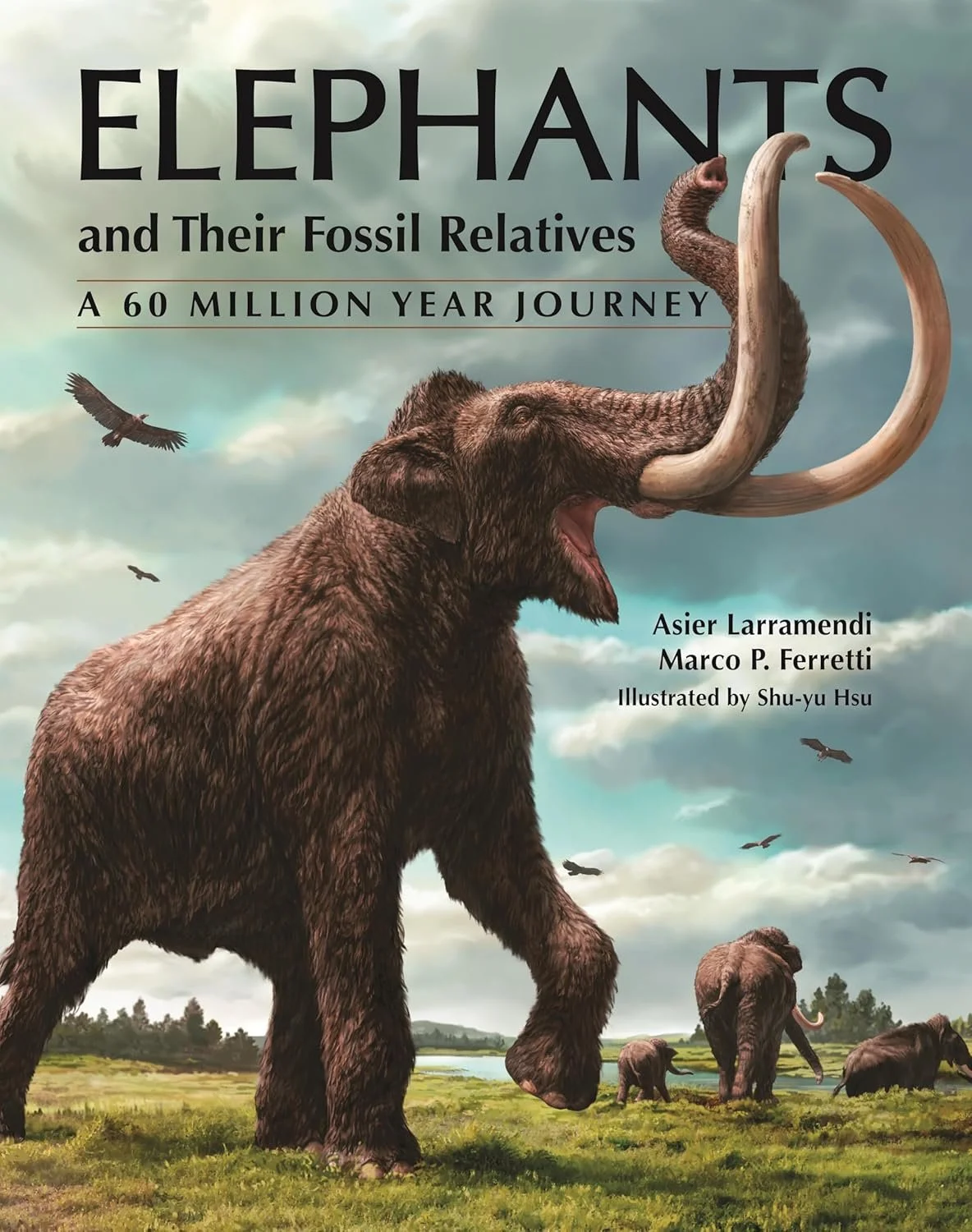
Elephants and Their Fossil Relatives: A 60 Million Year Journey
By Asier Larramendi & Marco P Ferretti
Princeton University Press 2026
It’s a little-noted axiom but no less true for that: the easier it is to write a book on Subject A, the harder it will be to find a genuinely good book on Subject B. This will doubtless get even more axiomatic as AI begins to write not just some of the books but all of them, but even now, if an author is getting paid merely to slap together an easy book on the London of Charles Dickens or the elusive wonder of house cats, it will harrow the very essence of their sybaritic souls to slap together a difficult book on those subjects. Hence the vast midden-heaps of lousy books on almost every subject.
And hence the alarm-bells that might sound at the appearance of an oversized and heavily illustrated new book on elephants just like this new volume from Princeton University Press. Elephants and Their Fossil Relatives by experts Asier Larramendi and Marco Ferretti. It’s easy to imagine what a book like this could be: mentions of circus performances, for instance, glancing references to Tarzan and Hannibal, a subtitle along the lines of “Nature’s Giants,” and presto! You’ve got a book. A certain card of book, anyway.
Thanks be to Lord Ganesha, Elephants and Their Fossil Relatives is not that kind of book. If anything, it’s the exact opposite: a magnificently in-depth and unapologetically nerdy study of not just the tiny handful of elephant species still extant but also of the hundreds of proboscidean species that fill the fossil record (and are beautifully illustrated here by Shu-yu Hsu).
This parade of proboscideans brings to light the whole long evolutionary chain of these animals (not all of which were enormous; judging from the size scales provided, dozens of these species were only human-tall), from their rise in the Paleocene to their sorry state today, with only three living species of elephant, all three endangered and down some 96% from their documented peak population densities. Each species, past and present, is profiled and described, from creatures the size of beagles to Paleoloxodon namadicus, which arose in India in the late Pleistocene and towered over its world:
As tall as a giraffe and as heavy as three African savanna male elephants, this whopping proboscidean was likely the largest land mammal of all time. The most remarkable feature of the Narmada elephant is its exceptionally developed parieto-occipital crest (POC). In males, it is so prominent that it overhands the external nasal aperture, resembling an elephant head on steroids. Extraordinarily powerful and large muscles must have attached to this bony structure, making the head of the largest males possibly the heaviest of any land vertebrate in history, comparable to the mass of an adult male white rhinoceros!
As mentioned, the authors don’t hesitate to geek out all over their subject, losing sight with charming regularity of whether or not most of their readers have the first idea what they’re talking about:
One of the most common methods for estimating the body mass of extinct tetrapods is based on regression equation of body mass on limb bone variables obtained from analysis of extant taxa. The most frequently used equations, especially for their easy of application, are those based on stylopodial (humerus and femur) minimum circumferences.
Luckily, they vary things up with some cryptozoology, noting that in 1944, several pilots flying over the snows of Alaska reported seeing a herd of mammoths walking in single file, and that in 1956 a school teacher from a village near Russia’s Taz Rive “spotted a mammoth while out picking mushrooms” (the teacher doing the picking, presumably).
There’s far too much information in Elephants and Their Fossil Relatives to absorb on the first or second read-through, which is marvelous and made all the more so by our authors’ skill at clarifying even those geeky subjects in which they indulge. Readers will learn how thick elephant skin is, how heavy their trunks are, how big their hearts are, and they’ll have at their fingertips a full-color visual record of how all those things have varied over the millennia. The book is a gigantic achievement.
Steve Donoghue is a founding editor of Open Letters Monthly. His book criticism has appeared in The Washington Post, The American Conservative, The Spectator, The Wall Street Journal, The National, and the Daily Star. He has written regularly for The Boston Globe, the Vineyard Gazette, and the Christian Science Monitor and is the Books editor of Georgia’s Big Canoe News