The Breath of the Gods by Simon Winchester
/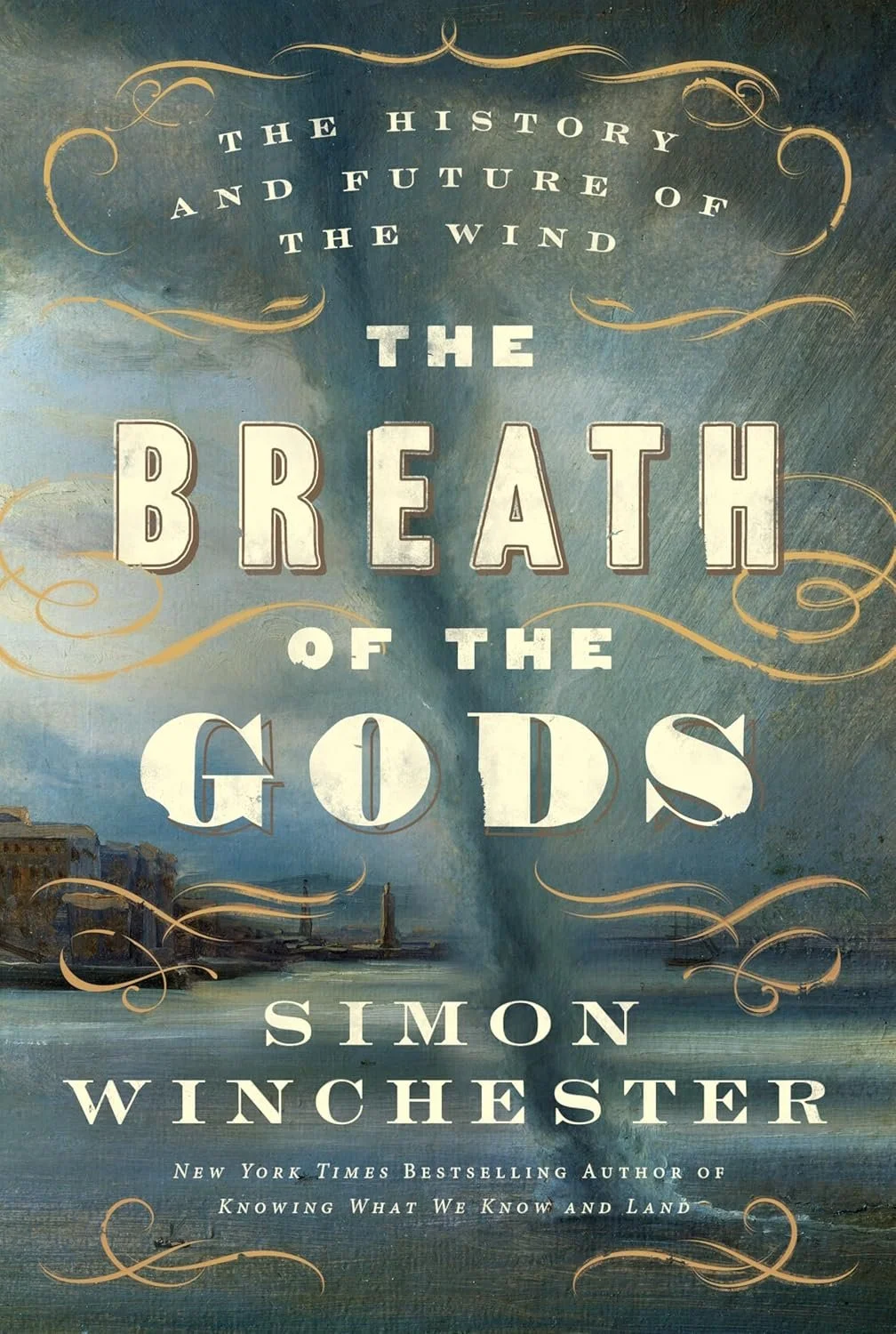
The Breath of the Gods: The History and Future of Wind
By Simon Winchester
Simon Winchester's latest work is titled The Breath of the Gods: The History and Future of the Wind. With over 30 nonfiction books covering major historical events, science, nature and travelogues, including The Professor and the Madman, about the creation of the Oxford English Dictionary, the ever-curious former journalist and world traveler extends naturally from his recent oceanic studies to an examination of wind.
This well-researched book is not theme-based but instead opts for an immense scope, covering almost every conceivable subject linked, sometimes tenuously, to the wind. Chapters are based on wind speed ranging from gentle to robust to inclement, containing subsections of detailed stories of typically three to five pages in length. Additional chapters with scientific explanations of wind formation and wind measurement techniques break up the narrative.
The book engages the Reader immediately with analysis of recent news and crucial historical events. Although the wind is not often the cause, it is the messenger, and it has a story to tell. From the health impacts due to wildfire smoke a country away to radioactive fallout from Chernobyl and resultant cancer winds destroying families, even gentle winds can pack a punch. Whether serious topics or the mundane, Winchester's research adds important insights to subjects not usually top of mind but no less interesting. Consider the ubiquitous tumbleweed:
Hollywood used to have a decided fondness for tumbleweed imagery during the heyday of the Western movie….In today's world with the American West no longer lonely and unpopulated, the wind-scattered tumbleweeds have become a menace - or at least have collided, quite literally, with what some might consider the equal menace of modern housing developments.
Wisely, the book does not immediately tackle the physics of wind formation, enabling the reader to acclimatize to the subject material. Yet the physics and meteorology components are carefully and logically presented with the non-scientific reader in mind. Winchester skillfully moves from the First Law of Thermodynamics, critical in wind formation, combined with the earth rotation to form the three major wind cells in the Northern Hemisphere. It does not end there:
It is these two junction points - the Hadley-Ferrel cell junction, and again at the Ferrel-polar cell junction-that the two great jet streams begin to slither and rage around the planet. Two in the Northern Hemisphere, and two farther to the South of the equator , each of them heading relentlessly eastward… As to what they do, that is now quite well known - and, in a single phrase, can be summed up as they wreak havoc.
Winchester describes the Great Stilling, a lengthy period where global winds have lessened. Climate change is touted as a possible cause, but the data has recently reversed. A different climate change impact was keenly felt in the winter of 2026, after the publication of this book. Did a weakening jet stream cause the polar vortex to drift, punishing America, Europe and Asia with a brutal cold? Although subject to more research and monitoring, wind cycles and jet stream formation (subject of an excellent chapter here) informs the reader about the potential of another unforeseen and unwelcomed global warming outcome.
Sailing, boat design and open sea adventuring, present-day and historical, are prominent in the book. For the uninitiated, how sailors induce forward motion when facing "into the wind" may surprise. Winchester deftly and delightfully employs the language of the sailor to describe sailing "close to the wind" and how "the craft will be said to be close-hauled and will start to heel."
Naturally, not all segments of this broad book will appeal equally. There were one too many examples of open sea battles being impacted by the wind. The examples of storms in classic literature seem out of place. Also, the tornado explanation appears rushed and lacks the solid scientific underpinnings found in the wind formation chapter. Still the inquisitive reader can glide through the text, diving into appealing sections while breezing over others. Human actions have consequences and the book’s best segments are where the wind reveals Man’s imprint, underscores our mistakes.
Winchester reminds us how the wind has shaped our world and how we live in it. To throw caution to the wind and ignore its latest signals is to our detriment.
Robert Genier is a former Economist with the Canadian government with housing markets, housing bubbles, operational risk management and climate change science knowledge.