Stephen Sondheim: Art Isn't Easy by Daniel Okrent
/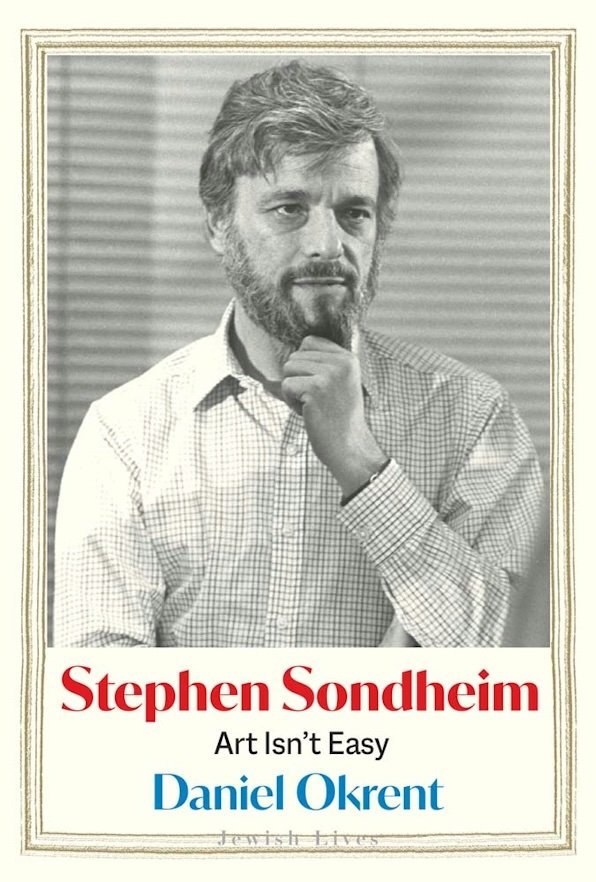
Stephen Sondheim: Art Isn’t Easy
By Daniel Okrent
Yale University Press, 2026
The death at 91 of Stephen Sondheim on November 26, 2021, was a seismic cultural event, certainly for his worshippers (a not inapt descriptor), but also for theatergoers who had come to admire and embrace what had once been caviar to the general. Few theater figures loom as large as Sondheim. His storied career spanned more than six decades, beginning when, as a tyro lyricist in his 20s, he teamed with seasoned professionals Arthur Laurents, Leonard Bernstein, and Jerome Robbins (together a quartet of gay/bi Jews, but not always in harmony) to create West Side Story, one of the genre’s sturdiest creations.
Two years later, Gypsy (his words to Jule Styne’s music) brought forth another enduring classic. When in 1963 he achieved his aspiration—music and lyrics—for a knockabout ancient Roman farce gone vaudeville, A Funny Thing Happened On The Way to the Forum, it was a sellout success, but to Sondheim’s ongoing frustration, critics by and large loved the lyrics but were indifferent to his music—this for a score that would one day be considered ingenious.
This critical dichotomy—lyrics great, music not—would bedevil the Milton Babbit-trained Sondheim throughout his career, and the psychological toll it took through much of his life is woven throughout Daniel Okrent’s excellent new biography, Stephen Sondheim: Art Isn’t Easy. The book is part of the estimable Jewish Lives series from Yale University Press, which offers biographies of figures from Einstein to Spielberg, Moses to Streisand. (Although Sondheim’s family were secular Jews—he didn’t attend a bar mitzvah until he was 20—he later said his identification with his Jewish heritage increased as he got older.)
In charting Sondheim’s life, Meryle Secrest got there first with a hefty volume in 1998. Stephen Sondheim: A Life served as Sondheim’s coming out, not that his homosexuality was a carefully guarded secret. But he was nearly 70 when the book was published. The next two decades were for him—as with Samuel Johnson—crowded with incident. Okrent, whose previous books chronicled Prohibition, baseball, and Rockefeller Center, and who never met Sondheim, may seem an outlier choice as a biographer, but he had at his disposal a vast amount of material from archivists, scholars, websites—as well as contemporary interviews with fans, associates, and friends. Sondheim himself supplied a great deal of information in several lengthy interviews over the years, and he frequently sat onstage to talk with the likes of Frank Rich, Anna Quindlen and Tony Kushner. And letters! One busy site, Sondheim Letters, now publishes much of his correspondence. He attributed the courtesy to his father, who told him that a gentleman answers every letter he receives. And for more granular details, a recently launched podcast, Loving You, comes replete with charming, cozy commentary by two Sondheim intimates: an old friend and his first romantic partner. Be prepared for tales of Oxford adventures and Bette Davis impersonations.
He was a native New Yorker. His father, Herbert Sondheim, a Manhattan dress manufacturer, shattered the family by leaving his wife and only child to marry another woman. Mrs. Sondheim, born Janet Fox and known as Foxy, was considered what used to be called a piece of work—an outsize, melodramatic figure embittered by her husband’s betrayal. Sondheim would forever hold her in contempt. “A monster” he called her, “creepy.” A “celebrity fucker,” too, yet that particular trait pushed him into the figurative arms of theater giant Oscar Hammerstein II, a Bucks County neighbor. Hammerstein’s mentorship and affection as a surrogate parent helped convince the boy that his love of music and verbal acuity could best be served by writing for the theater.
Okrent depicts his subject’s life and art with depth and economy—an impressive feat, given that Sondheim’s career from 1970 to 1994 saw him and his collaborators (primarily Harold Prince and James Lapine) deconstruct and reimagine the classic American musical.
A litany of their works—Company, Follies, A Little Night Music, Pacific Overtures, Sweeney Todd, Sunday in the Park With George, Into the Woods, Assassins, Passion—represents an astonishing bounty of creativity, but each production is discrete in its originality and execution. Even 1964’s Anyone Can Whistle, a nine-performance flop, has since been mined for some of Sondheim’s best songs.
Merrily We Roll Along in 1981 was the Sondheim-Prince duo’s most audacious project, a cautionary show business tale of money and fame’s corrosive poison—and one told backwards no less, and cast with young actors, talented but green. It was an historic flop, given the pedigrees of its creators. Sondheim was so flattened by the experience that he threatened to abandon his profession forever. Yet it inspired others over the next several decades to sift through the rubble and discover gold. The result: a sold-out award-winning Broadway revival two years ago, which sadly, its creators did not live to see.
Sondheim’s malaise lasted until he met James Lapine, an off-Broadway playwright/director more attuned to the experimental and abstract. Their brainstorming sessions, often marijuana-fueled, landed on a cockeyed idea: Georges Seurat and his pointillist painting A Sunday Afternoon on the Island of La Grand Jatte. Skeptics scoffed, preview audiences were confused, yet the creators held fast and picked up a Pulitzer. The pair then deconstructed classic fairy tales for Into the Woods, over the years Sondheim’s most frequently performed work.
Despite the ups and downs of his career, the productions by and large were classic examples of the succès d'estime, rarely rewarding investors. Yet the estimation of his art grew exponentially, as did his ardent fan base. Happily, Okrent works in the sweet spot between fandom and fanaticism. Here he skillfully dissects Sondheim’s lyric-writing art:
The verbal dexterity of [his] lyrics is so captivating that a listener’s focus is immediately and inevitably drawn away from the music to the words. But that listener should keep in mind a double truism: Music exists to say things that can’t be expressed in words, but when the two are carefully plaited, the music makes the words even better.
And extolling the virtues of “Send in the Clowns,” Sondheim’s only bona fide popular hit, from A Little Night Music, based on the Bergman film Smiles of a Summer Night:
[The song] can reach anyone, on its own terms, in any emotional circumstance that isn’t joyous; Ingamar Bergman even suggested he wanted the song played at his funeral. It is a contained, sustaining, glorious piece of songwriting—and its composer-lyricist happened to have written it overnight.
Okrent’s most affecting pages concern Sondheim’s failing creative powers. His final Broadway show, Passion was theatrical Marmite, a tortured tale of unrequited love (sort of) that frustrated as many as it captivated. Winning another Tony did not ensure a lengthy run. Sondheim then spent many years in the quixotic pursuit of musicalizing the lives of the Mizeners, two historic brothers who pursued success in various madcap ways. Multiple productions and four titles—Wise Guys, Gold!, Bounce, Road Show—couldn’t make it palatable or sensible. His final work, Here We Are, an adaptation of two Buñuel films, was a sad disappointment, although some favorable reviews suggest critics were averse to kicking him when he was dead. Okrent reports that Sondheim’s score was written out of obligation rather than inspiration.
Yet his last decades were also intensely gratifying. He saw major revivals of his work, both in the states and internationally. There were celebratory sold-out concerts, starry stage revues of his songs, an Oscar that gave him EGOT status, and another Tony for Lifetime Achievement, two superb, influential volumes of his collected lyrics with incisive commentary, and the rare honor of a Broadway theater named for him. And there were always the Brits, who often championed his work more warmly than Broadway did.
In the center of these remarkable accomplishments was the man himself—alternately irascible, sentimental (“Drop a hat and I’ll cry”), resentful, fun-loving, shy. Loved puzzles and classic films, hated opera and Bob Dylan. A great friend and a powerful enemy. A generous teacher and mentor. Okrent connects the pervasive dark cloud that seemed to follow him to his mother’s poisonous influence, as well as the critical indifference to his composing accomplishments. Frequent shrink sessions helped, but not Alcoholics Anonymous. His obsessive drinking was no secret to those who knew him; it was ongoing and apparent, and his one visit to an AA meeting was his last. Yet friends insisted that he had a “vast capacity for liquor” without exhibiting any change in his demeanor.
That the clouds began to brighten was attributed domestic bliss. Closeted for much of his life, he came out to Secrest in her book by describing his relationship with composer Peter E. Jones. Years later he married Jeff Romley, a man several decades his junior; they lived on an estate in Connecticut—with two poodles—until Sondheim’s death. He was observed as a gentler, more contented man. According to Okrent, “Friends . . . were almost unanimous in believing that the elderly Sondheim was the best Sondheim they had known.”
At the beginning of his book, Okrent recounts an anecdote that Hal Prince’s wife Judy (Sondheim called her his Muse), upon hearing a few of the songs proposed for Sweeney Todd, exclaimed to the composer that the tale of a razor-yielding madman bent on revenge was the story of his life. How her pronouncement turned out to be prescient is the spine of the biography—which will certainly not be the last on the subject, but may well be the one by which all the others will be judged.
Michael Adams is a writer and editor living in New York City. He holds a PhD from Northwestern University in Performance Studies.