This Vast Enterprise by Craig Fehrman
/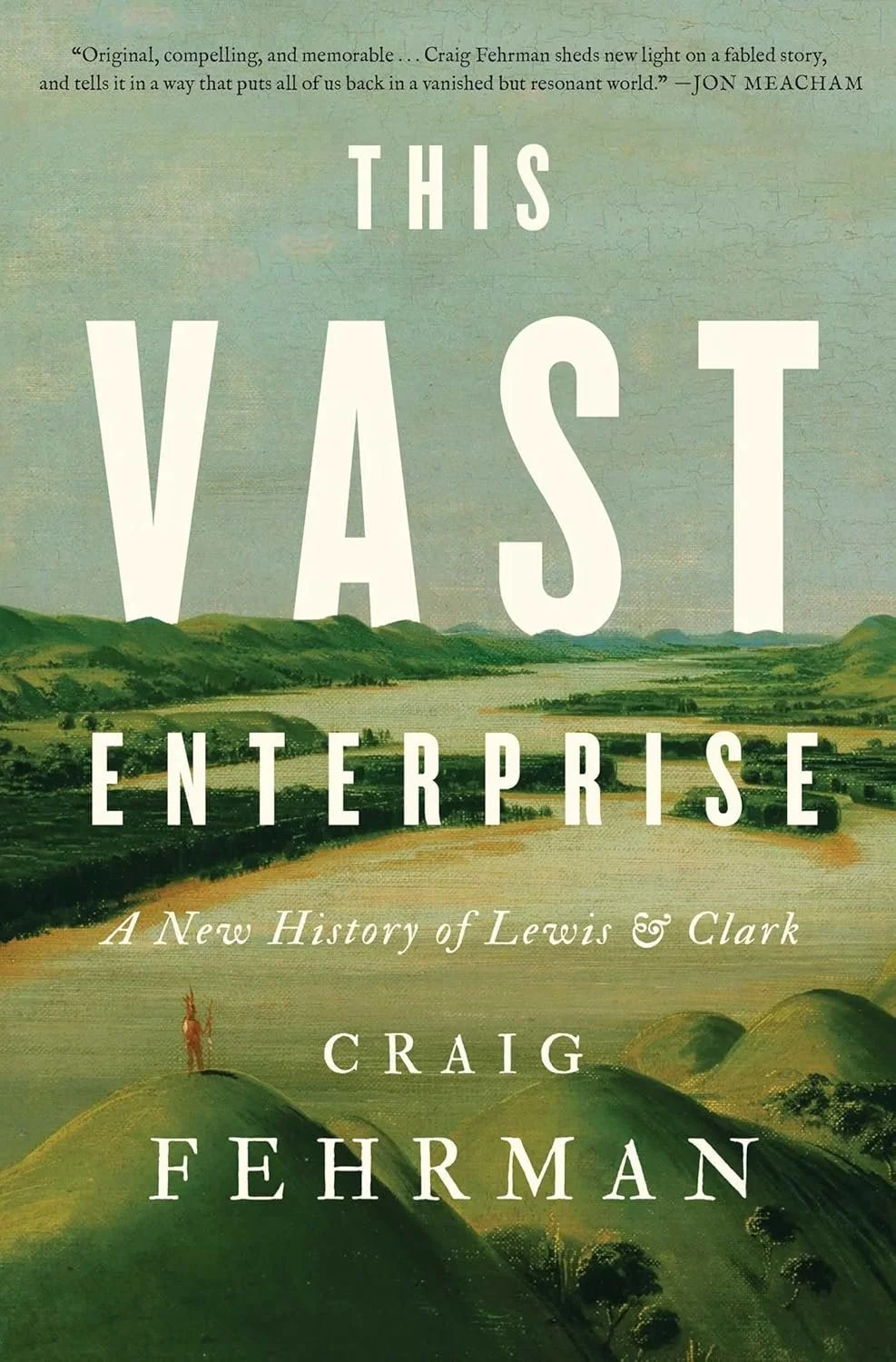
This Vast Enterprise: A New History of Lewis & Clark
By Craig Fehrman
Avid Reader Press 2026
Craig Fehrman, author of 2020’s exuberant Author in Chief, concentrates in his newest book on one particular US President, Thomas Jefferson, and what is arguably the most famous product of his presidency, the Lewis & Clark Expedition of 1804-5, in which the Corps of Discovery left Illinois, traveled the Missouri and Columbia Rivers through a wild new country inhabited by a mosaic of Native American nations, and all the way to the Pacific Coast. The Lewis & Clark Expedition has been the subject of a mighty mound of writing, from histories to biographies streams of historical fiction to stage plays and even a couple of operas, and that naturally opens the door to a great deal of mythologizing.
This mythologizing takes a serious and thoroughly delightful pounding in This Vast Enterprise, since although Fehrman doubtless grew up with the mythology same as most Americans, “Lewis and Clark as timeless, all-American epic, well suited for family road trips and high school history, our astronauts in canoes.” But the real account was not only far more complicated but, as Fehrman rightly notes and then proceeds to demonstrate, a much better story.
In telling this story of what he calls “a sprawling and federally funded military operation,” (a persistent characterization in histories of the event, even though the Corps consisted of a couple-dozen drunken stumblebums who wore no uniforms, carried no heavy harms or ordinance, did no drilling, and had no military orders, aims, or tactics) Fehrman shifts his narrative focus chapter-by-chapter, from obsessive worrywart Lewis to redoubtable standfast Clark to Clark’s personal slave York to Everyman soldier John Ordway to Lakota leader Black Buffalo and of course to Sacajawea, who encountered the explorers through the loathsome Toussaint Charbonneau (“The captains understood that ‘wife’ was a euphemism,” Fehrman writes. “Years later, Clark chose a more accurate word: ‘slave.’”). There’s even a big fluffy Newfoundland named Seaman.
This multi-viewpoint narrative structure ends up being spectacularly effective. Fehrman writes with a sparser, punchier prose line than he used in Author in Chief, and it perfectly matches both his subject matter, which is, after all, an exciting adventure, and his larger narrative aim, which is to make this familiar story feel new. And he knows when to step back and let the odd, offhand cruelties of the tale speak for themselves:
It had been a long day, as most days on the expedition were. Tomorrow on one of his solitary walks, Lewis would pass a herd of a thousand buffalo. He would shoot one, watching it die – “the poor animal discharging blood in streams from his mouth and nostrils” – and he would forget to reload his rifle. He would turn and see a grizzly had crept up on him. The bear was fifty feet away. Lewis would sprint into the Missouri and spin around, gripping his espontoon and hoping that it and the current would give him a chance in this fight, though he knew it would not. He would watch the bear rumble up to the water’s edge, stop, and turn away.
Readers seeking more context than was provided in Bernard DeVoto’s superb edition of the Expedition’s journals, and perhaps also seeking to avoid the somewhat static pomposity of Stephen Ambrose’s 1996 bestseller Undaunted Courage, will find an immensely satisfying alternative here.
Steve Donoghue is a founding editor of Open Letters Monthly. His book criticism has appeared in The Washington Post, The American Conservative, The Spectator, The Wall Street Journal, The National, and the Daily Star. He has written regularly for The Boston Globe, the Vineyard Gazette, and the Christian Science Monitor and is the Books editor of Georgia’s Big Canoe News