Unsayable by Michael Cunningham
/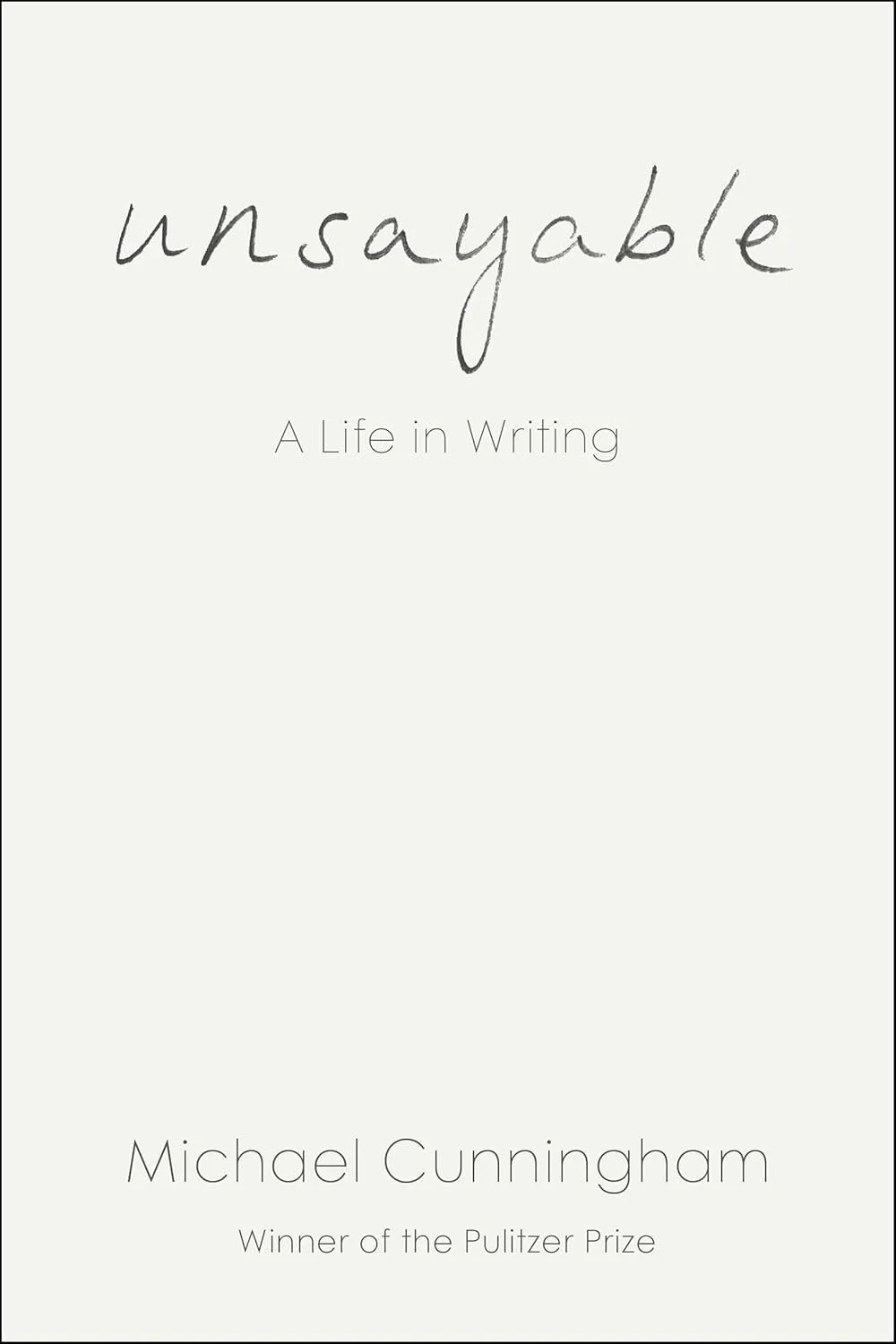
Unsayable: A Life in Writing
By Michael Cunningham
Random House 2026
Apparently there’s a kind of bookworm peril incumbent in the writing of a writer’s writing memoir. Delve into too much detail about the specific mechanics of your craft, and you’re accused by all posterity of being a mere rude mechanical, a saucy mender of men’s souls; skirt too many of those details and you’re accused by all posterity of being coquettish and elusive. Any writer wanting to write a navel-gazing memoir, it seems in other words, is caught between Anthony Trollope’s autobiography and Edith Wharton’s A Backward Glance. It’s puzzling. Writers are constantly thinking (and talking) about themselves, after all, and writing is what they do; reticence might feel more natural in the memoir of a bashful steelworker.
Since Michael Cunningham’s new writer’s memoir, Unsayable is well under 300 pages, and since its chapters strain to reach five pages apiece, and since its author teaches writing for a very, very good living, it might be expected that he’d avoid either of these extremes and just deliver what his book’s subtitle promises: a life in writing.
But Unsayable would have been much more accurately if less catchily subtitled “a gay life with occasional writing thrown in.” At a couple-dozen points in a narrative that, again, isn’t exactly Proustian in length, our author seems to be making a wrenching mental effort not to write a writing life. When he’s mistily recounting his senior year at Stanford traveling to San Francisco to turn tricks for spending money, for instance, he’s fulsome (and characteristically evocative) enough to recount some details of a particular encounter with a man rude enough to be old:
I didn’t find him alluring, but neither did I find him repulsive, with his half-basketball belly and the eagle-shaped tangle of dark chest hair that spread wings across his pectorals and diminished down to his groin. The skin of his shoulders and chest was mottled, splotches of pallid pink that looked like a rash impervious to healing, and, at an oblique diagonal to his left hip, the whitish line of a scar, surgery of some sort. The minor wounds accrued in the battle of aging.
But then he abruptly stops himself, Wharton-style, from actually reflecting on the encounter. “I’m afraid I lack the courage to recount our entire conversation,” he writes. “I do, as it turns out, have some shame.” Darling, page 124 of your own goddam memoir isn’t the ideal time to discover discretion.
Or to re-discover it repeatedly, as when he decides that a memoir about a life in writing would be the perfect venue for avoiding the boring old topic of all the writing jobs he’s had. “In the interests of economy,” he writes, “I’m going to skip over my teaching jobs at Columbia and Brooklyn College (although there’s plenty to say about both), and concentrate on my current job, at Yale.” Interests of economy? Again, the book is 275 pages soaking wet. Maybe cutting the dozens and dozens and dozens of pages devoted to gawking at fellow pretty boys (including an aria to a dead crush that would have been effective if it weren’t so ham-fistedly manipulative) might have freed up space for the nominal subject at hand.
Fortunately, that subject, a life in writing, does crop up enough times to make for some intermittently interesting reading. In far less detail than any reader will want (particularly the many, many readers who rightly love this author’s fiction), Cunningham does spend some time discussing some of the practical aspects of the writer’s life, things like dreading various rounds of deep revisions on a finished novel and the like. True, he tells some genuine whoppers, the kinds of lies that are so common coming from authors that they’re practically tradition. He mentions, along these lines, that not only has he forgotten the gory details of Michiko Kakutani’s excoriating review of his novel Flesh and Blood but that he didn’t save a copy, when of course he can quote the whole thing from memory and probably has a crumpled copy of it under his pillow. Writers can be so cute sometimes.
And he’s every bit as good at atmospherics in this memoir as he is in all his fiction. Take this terrifying glimpse of peaceful, unassuming little Iowa City, where he spent two years at the Writers’ Workshop. Delicate little chrysanthemum that he apparently is, he describes the place as Mad Max’s Thunderdome: “If you were to pass through Iowa City during one of its temperate periods – in autumn before the freeze blows in, in spring before the summer sun liquefies the tar on the streets – it would strike you as bucolic and innocent,” he writes, before really ramping things up. “If you stay for a couple of years, though, you come to appreciate the effort required to build a town there at all, on an expanse of fertile earth (the soil is like chocolate cake batter) where, nevertheless, tornadoes are common and where the weather, most of the year, would annihilate you if you were unprepared, by way either of air so cold it would stop your breath or of heat so severe that if you buy a bouquet of congratulatory roses for a friend and carry them for several blocks, they will have shriveled and dropped their petals.” Yeesh – how did frail little Flannery O’Connor survive?
At one point Cunningham describes a career as a novelist as “a life spent as an amateur,” and it’s that note of sincere modesty, sounded so regularly, that ultimately saves this memoir even from itself. Coquettish? Sure, sometimes, but who doesn’t find that diverting from time to time?
Steve Donoghue is a founding editor of Open Letters Monthly. His book criticism has appeared in The Washington Post, The American Conservative, The Spectator, The Wall Street Journal, The National, and the Daily Star. He has written regularly for The Boston Globe, the Vineyard Gazette, and the Christian Science Monitor and is the Books editor of Georgia’s Big Canoe News