Custom Made Woman by Alice Gerrard
/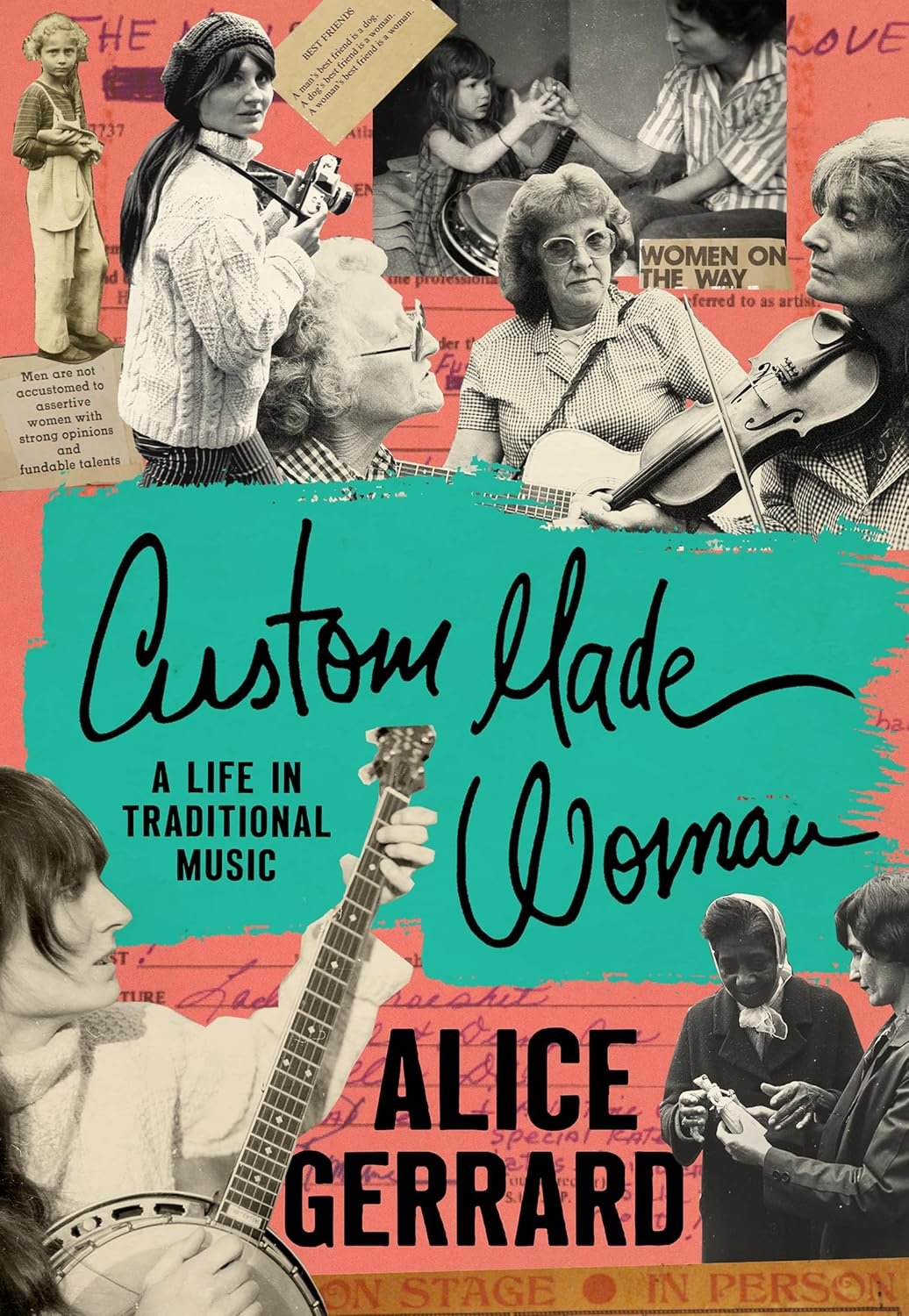
Custom Made Woman: a Life in Traditional Music
by Alice Gerrard
University of North Carolina Press 2025
The singer, songwriter, and journalist Alice Gerrard has had a long and varied career as a member of the pioneering vocal duo Hazel and Alice, the founder of the journal The Old Time Herald and a producer of recordings and concerts. Though she does not go out of her way to emphasize it, Gerrard’s new memoir makes clear how unlikely it was that any of that should have been possible. Gerrard describes herself: “I’m a musician, songwriter, twice a wife, four times a mother, a sister, once widowed and once divorced.” As a single mother of four, widowed by an automobile accident in 1964, she was able to raise her children with the help of “maximum Social Security (Thank you, Franklin Roosevelt!!).” Living frugally, she was able to raise her children and explore music and photography without having to get a “day job.”
Her introduction to folk music was a common one for the time and place. Her boyfriend at Antioch College gave her a copy of the Anthology of American Folk Music in the 1950s. A six-LP reissue of historic recordings that included blues, ballads, fiddle tunes, jug bands, and cajun music, the Anthology launched countless revivalist musicians. Gerrard learned guitar and banjo. After marrying that boyfriend, and moving to the Washington, DC area, Gerrard had access to a wealth of musicians who were living connections to the traditions collected on those records.
One of these, West Virginia native Hazel Dickens, would become Gerrard’s musical partner for four albums. Gerrard devotes a chapter to Dickens, a fiercely independent woman with a keening voice and a sharp songwriter’s pen:
She didn’t immediately trust anyone and liked keeping her “business” to herself. Country smart, she’d grown up hard and poor… Hazel had a singing voice that could nail you to the wall, the kind of voice that embodied the “high lonesome sound” to me…. I was in awe of Hazel’s singing, trying to grasp hold of its mysterious power for a long time, listening to her as a mentor, learning from her. She was older, generally streetwise and street-smart, and in this world of music and bridging cultures, with her innately suspicious and private nature, she knew what was best.
Another important figure in Gerrard’s life was her second husband, the musician and documentarian Mike Seeger. The two established a blended family homestead in rural Maryland, which served as a base for touring (Seeger was a member of the influential revivalist trio the New Lost City Ramblers) and documenting traditional musicians in Virginia, North Carolina and Kentucky. For fans of traditional music, the list of musicians recorded and documented by Gerrard and Seeger is a jaw-dropping parade of greats: Ola Belle Reed, Tommy Jarrell, Elizabeth Cotton, Dock Boggs, Bill Monroe (for some reason called the “Grandfather” of Bluegrass rather than the father), Jenes Cottrell, Enoch Rutherford. Original photographs and capsule biographies of many of these figures make up a large part of this book.
In the 1980s Gerrard relocated to the de-industrializing town of Galax, in southwestern Virginia, and founded the Old Time Herald, a magazine that served the makers and fans of string-band and ballad based music through interviews, articles and record reviews. From the very beginning, Gerrard has strong opinions on what she wanted the Herald to be:
I … felt that the magazine should have a color cover, glossy pages, not mimeographed … and felt that this would make it more credible. I felt strongly that it shouldn’t be a fan magazine or an academic publication but should present articles of interest and importance, that it should reach out not just to aficionados but to many different people, and that it should be accessible to all. I felt strongly that reviews should be critical. They were intended to reflect the state of the art and not just be fanzine-style reviews. This generated… some outraged responses and hurt feelings.
Hurt feelings, aside, the Herald was the journal of record for this subculture for over thirty years.
Custom Made Woman — the title is also the name of a song on the first Hazel and Alice album — is a casual, conversational memoir of someone who worked largely behind the scenes and on her own to practice and to promote the culture that she loved. Gerrard is always personable and engaging on the page, occasionally self-deprecating. It is a bit too much of an insider’s account to serve as an introduction to blues and old time music. But is highly recommended for musicians and those curious about the later folk revival. If you know the players listed a few paragraphs above the present one, you’ll find dozens of beautiful photographs, some surprising anecdotes and a lot of interest.
James Ruchala is a banjo player with a YouTube channel.