Somewhere, a Boy and a Bear by Gyles Brandreth
/
Somewhere, a Boy and a Bear: A.A. Milne and the Creation of “Winnie-the-Pooh”
By Gyles Brandreth
St. Martin’s Press, 2025
2026 marks the 100th birthday of that most peaceable of bears, Winnie-the-Pooh. Derived from stories British humorist A.A. Milne told his son, Christopher Robin, about the adventures of Christopher’s stuffed animals in the woods behind the Milnes’ Sussex farmhouse, Milne’s Winnie-the-Pooh was an instant success. Published in October 1926, the book sold 150,000 copies by Christmas. A sequel, The House at Pooh Corner (introducing Poohsticks and Tigger), was published with similar success in 1928. When Walt Disney, having bought the film rights to Pooh and co., made his first animated Pooh film in 1966, Pooh’s immortality was doubly insured. By the mid-2010s, Pooh had “become the third bestselling franchise in the world.”
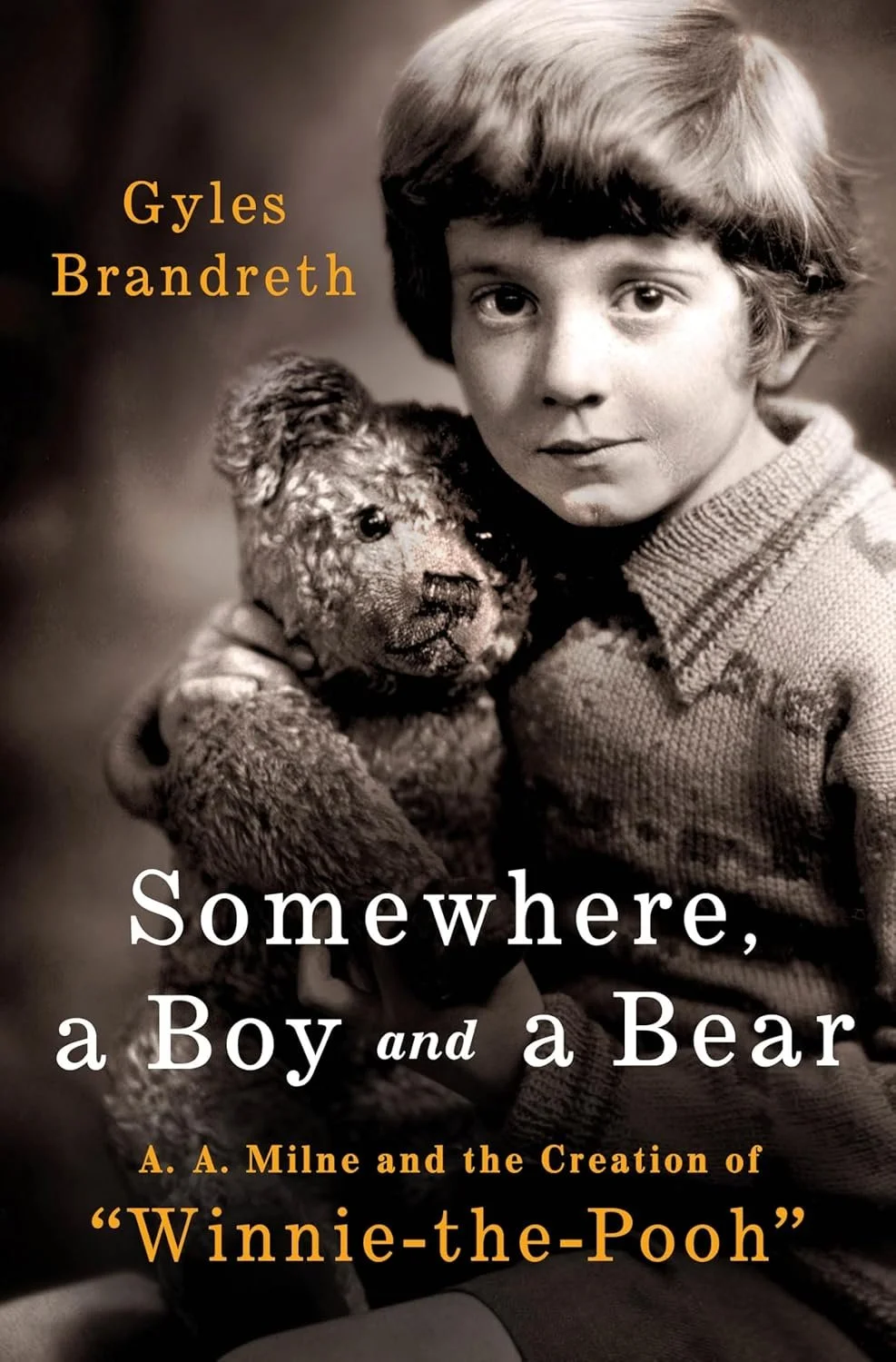
It is to be expected, then, that many writers will seek to celebrate (cynics might say cash in on) Pooh’s centenary. Gyles Brandreth got ahead of the game and published his book on Pooh in December 2025, just in time for the Christmas Season and complete with a charming cover photo of little Christopher Robin clutching his Pooh Bear and with photographs of the original stuffed animals (now on display at the New York Public Library) as endpapers. Despite what one’s first suspicions of this rather giftable book may be, Brandreth’s Somewhere, a Boy and a Bear: A.A. Milne and the Creation of “Winnie-the-Pooh” is actually a work of some substance.
Brandreth himself has previous Pooh credentials, having founded a teddy bear museum in Yorkshire and written a 1986 play on A.A. Milne’s life, Now We Are Sixty, during the writing of which he got to know the real-life Christopher Robin. It is upon his interviews with Christopher Robin (who died in 1996), along with Christopher’s memoirs and A.A. Milne’s autobiography, that Brandreth bases much of his book. Indeed, while Brandreth narrates, in a prologue, his search through the 10 boxes of A.A. Milne papers at the University of Texas at Austin, he does not seem to have made too much use of them in Somewhere, a Boy and a Bear.
But if not a towering work of scholarship, Somewhere, a Boy and a Bear is a pleasant and levelheaded study of Pooh’s genesis and the life of his creator. Brandreth treats Pooh unpretentiously, basking in his cutesy charm and appreciating the sweet (honeyish?) nostalgia that Pooh and his friends have invoked in countless adults down the decades. For Winnie-the-Pooh and The House at Pooh Corner are escapist books of the purest quality. Milne was, as Brandreth says, “from first to last … foremost an entertainer,” and one who liked to keep stories “simple and close to home.” This melded well with the blissfully innocent world of childhood that Milne sought to portray in the Pooh books, written, as so much literature of the 1920s was, in hopes of escaping, however briefly, the tumult of the post-World War I world.
Milne famously found himself trapped by his escapist children’s books (the two about Pooh and the children’s verse collections When We Were Very Young and Now We Are Six), forever labeled as a “whimsical” (Milne loathed the word) children’s writer—even while he continued to produce heaps of adult novels and plays, humorous articles and verses, all done in the lightly witty, fluffy manner so typical of the 1910s and ’20s, and all so easily forgotten.
Brandreth has not forgotten them, and chronicles all of Milne’s career—before, after, and while he was becoming A.A. (“Whimsy-the-Pooh”) Milne, as Dorothy Parker called him. Brandreth’s narrative is pleasant and mildly informative, never breaking new ground or saying anything profound, full of the expected banalities about how “childhood is the key to everything” and “truly, childhood lasts a lifetime” and so forth. It has none of the grandeur of Ann Thwaite’s 1990 biography of Milne (which Brandreth freely acknowledges is “‘the’ Milne biography”) or the polished charm and wry wit of A.A. Milne’s own autobiography, It’s Too Late Now (recently reprinted by Duckworth Books). But, for those who have never read about Milne and might not want something so detailed as Thwaite’s book, Somewhere, a Boy and a Bear would make an agreeable introduction.
Readers will, though, have to tolerate an annoyance found in neither Ann Thwaite’s biography nor Milne’s autobiography: Copious personal anecdotes about Brandreth himself. When, for instance, Brandreth is narrating undergraduate A.A. Milne’s joy at being asked to contribute to the popular humor magazine Punch, he rather pointlessly burbles right into a self-serving “personal aside”: “I remember, in 1969, when I was an Oxford undergraduate, President of the Oxford Union and an editor of Isis, the Oxford equivalent of The Granta [the Cambridge student magazine Milne edited], I was invited by the then editor of Punch, William Davis, to contribute to the magazine…. It was such a thrill.” And, when Brandreth is discussing Milne’s marriage: “Marriage is an honourable estate, but one that is fraught with challenges. I know. I have been married for more than fifty years…. Overall, I suspect A.A. Milne’s marriage was less happy than mine has been.” Even Tigger might find such random egotism bad form.
Spencer Peacock is a student currently living in Utah