Cyclops Cave by Don Schofield
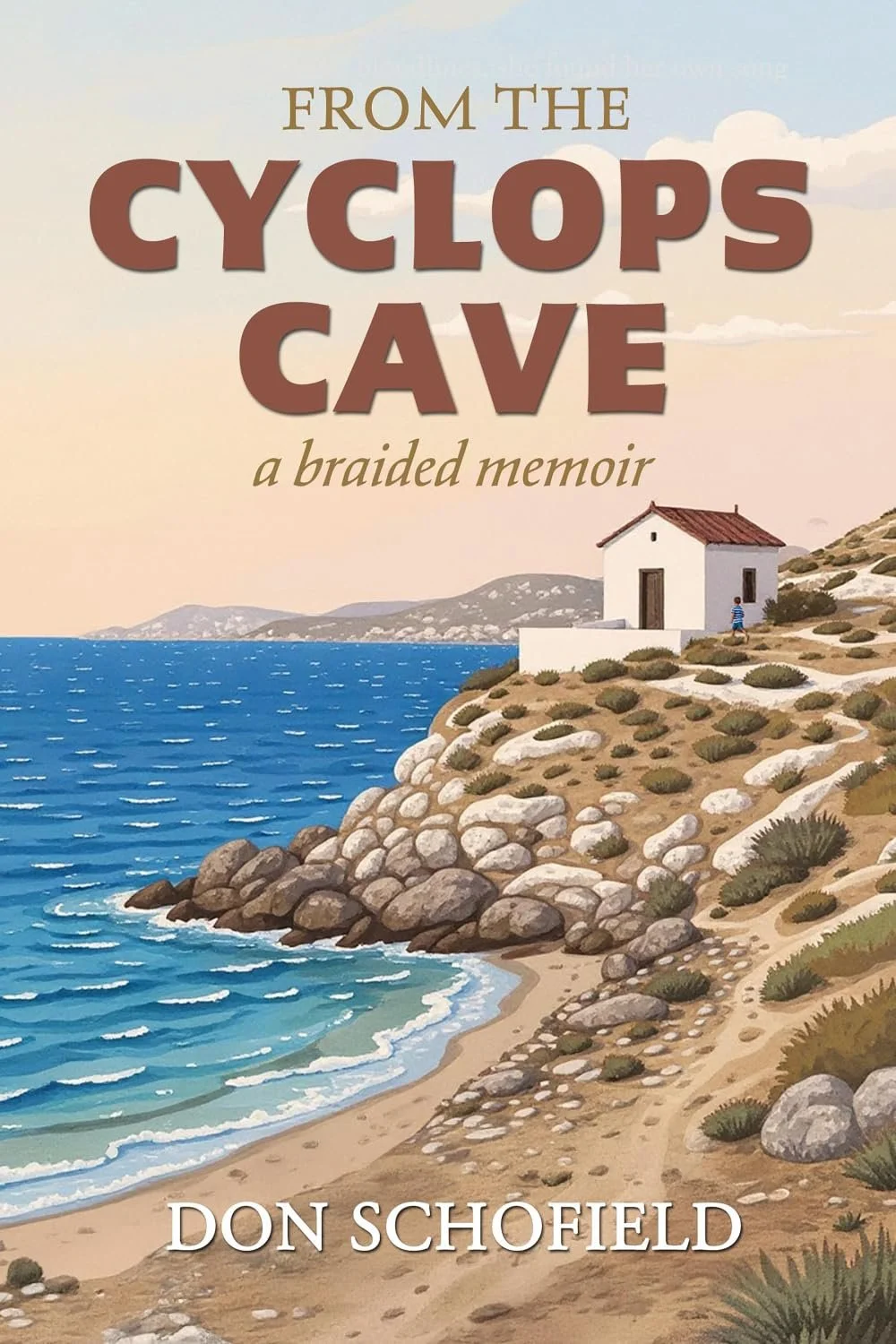
/
From the Cyclops Cave
By Don Schofield
Open Books, 2025
Immediate disclosure: this memoir written in and about Greece probably came to me because, like its American author, I have spent time in that country. But Schofield and I are very different: he hates Athens and loves living by an island village; I’ve toured islands but would live no place other than Athens. He is now a citizen; I am a sometimes summer resident. He speaks Greek; I don’t. Since Greece attracts about ten million foreign tourists a year, many of whom say they love the country, the publisher of From the Cyclops Cave assumed some of them would want to know what expatriate life would be like there—and sent me the book for possible review. I know enough about being a “xenos,” a stranger in “Ellas,” to say that Schofield is a perceptive and objective guide to off-the-grid island reality that tourists tend to romanticize.
He has Anglophone competitors. The classic is Henry Miller’s Colossus of Maroussi. In fiction, John Fowles’ The Magus, Don DeLillo’s The Names, and Rachel Cusk’s Outline all “do” islands. None of those writers lived in Greece for fourteen years, the period between Schofield’s arrival in 1980 and 1994 when he spends summer months on Kythnos where he recalls an unhappy California childhood and outlaw teens that included two stolen cars. I usually have little patience for memoirists who seem to be working from details of their childhood recorded on hours of videotape, but Schofield was no doubt internally imprinted by the trauma of his early life—that explains his attraction to what he calls the “Fortress of Solitude” that he celebrates on Kythnos.
Born in 1950, Schofield at the age of four was given to a virtual stranger by his divorced father. This woman soon passed the boy on to a Fresno couple who were unofficial foster parents. Pap (what Huck Finn called his father) was violent with his wife Nan and Don, who goes back to live in Sacramento with his largely absent father and new wife, an evil stepmother. She forces Don back to Fresno and more violence. Eventually he is placed in residential Catholic schools in Sacramento where he is bullied by fellow students and supervisors.
Schofield reports these early years in great detail and then radically foreshortens in the last few pages of From the Cyclops Cave his teen years of drug use and petty crime. He can recall with remarkable precision the feelings of his childhood. I wanted to know how he was thinking about himself during his teens before he finally enrolled in a college. Another few pages later and he’s receiving a Master’s degree in English and heading to another graduate program in Montana.
Unloved and beaten as a child, Schofield tried to protect himself by escaping to private spaces where he can be alone. When he goes to Kythnos to search for a summer rental, he finds a house as far as possible from others, basically a hovel that natives call “Cyclops cave.” Not a very accurate name, at least for Schofield: instead of the rage of Homer’s Polyphemus, Schofield experiences mostly calm in the cave. He recalls his past, writes in his journal, goes for swims and walks, and discovers that his distant neighbors are welcoming and generous, as well as curious about why he would want to live so far from traditional village intimacy.
Although a much-published poet, Schofield is no gauzy describer of Greek nature, its sounds and smells, the fresh vegetables and fruit that he eats, the look of light on the Aegean at different times of day. He reports remote hardships, getting water from the good well to drink, from the bad well to wash with. He’s not just in retreat; he takes pleasure in daily activities. He embraces physical challenges. This Greek material Schofield alternates with memories of his American youth.
The way Schofield lives is attractive, but prospective settlers should remember: Schofield can converse in Greek with those friendly neighbors, and the summer solitude he praises would be oppressive in the winter. I knew an American poet who tried to winter cheap in a village on Hydra, and retreated to Athens in January. In an unhappy ending to his creative sojourn, Schofield finds that his beloved rental cave will be sold as his part of the island tries to attract tourists. Another home gone.
Schofield has chosen to present two relatively short periods of extremes, a few years in California when his name is Gordon, a few weeks in Greece long after he has changed his name to Don. Something like Gordon’s American youth is familiar to readers from scads of child-abuse memoirs. Don’s adult years in Greece would be unfamiliar, perhaps more interesting to American readers (not just me). He does write a few pages on his marriage to a Greek woman that ended in divorce, and briefly describes teaching at a college in Athens, but I wondered about his 30 expatriate years since the summer of 1994 in Kythnos. If he didn’t return there to live, how did he cope with the horror of his childhood? Was writing his books of poetry his movable “fortress”? Did he ever have a child to treat with the love denied young Don?
If From the Cyclops Cave were a novel, the reader wouldn’t ask these questions, but a memoir elicits them. I’m not suggesting that Schofield’s book should be 800 pages, only that it might usefully have been differently proportioned—and have reported how the healing period on the island affected a mainland life. As a boy, Don had one of those inflatable figures you could punch and, weighted on the bottom, it would pop right back up with a grin on its face. I wondered if that was a factual detail or a poet’s metaphor of the limited life Don Schofield chooses to tell.
Tom LeClair has published three novels set in Greece—Passing Off, Well-Founded Fear, and Passing Again.