I Give You My Silence by Mario Vargas Llosa
/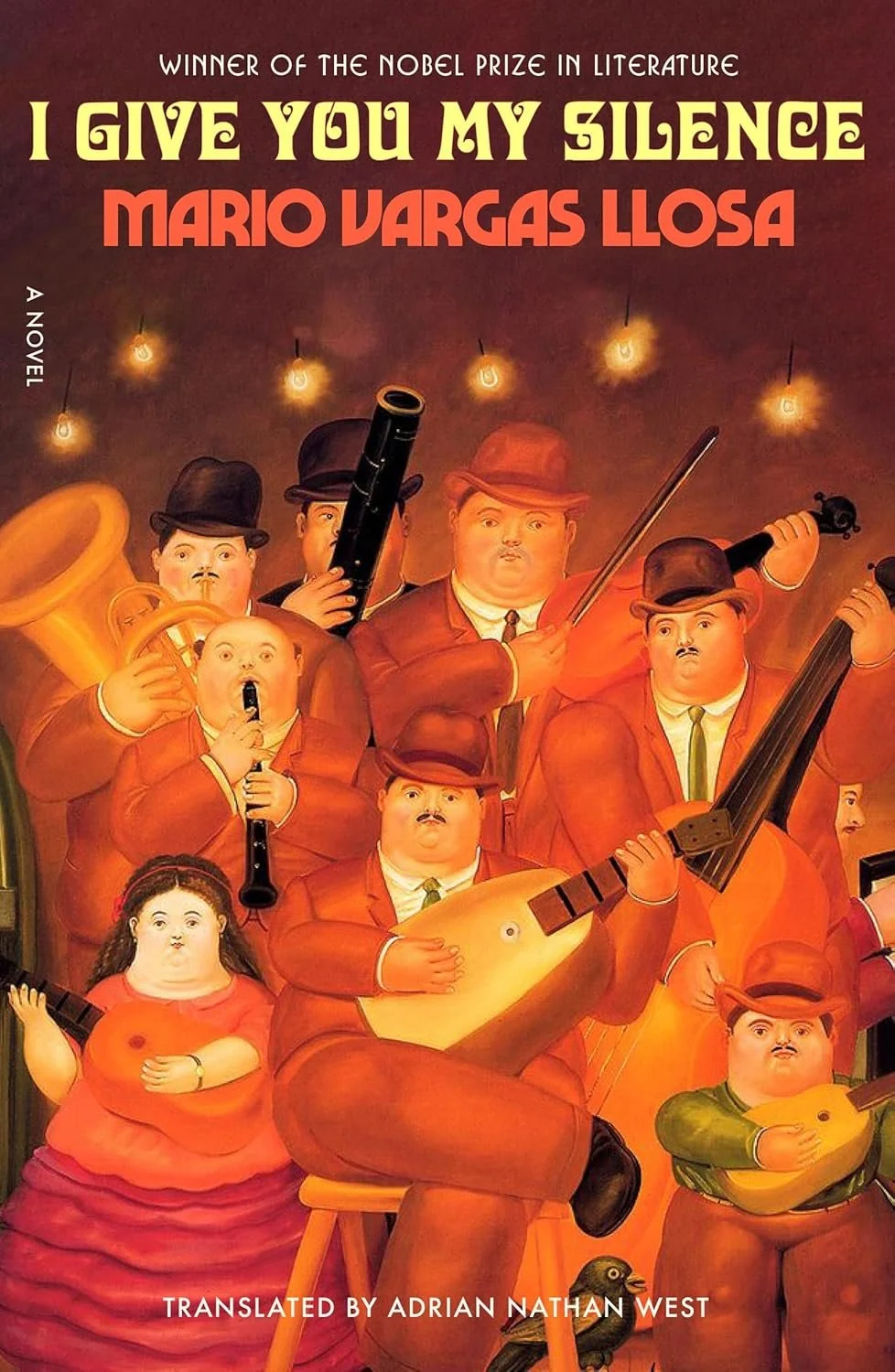
I Give You My Silence
By Mario Vargas Llosa
Translated by Adrian Nathan West
Farrar, Straus & Giroux 2026
The great Peruvian writer Mario Vargas Llosa died a year ago, and now his American publisher has brought out his last final novel, 2023’s Le dedico me silencio, here translated into English as I Give You My Silence by Adrian Nathan West (rather than I Dedicate My Silence, even though songs are dedicated to people and people are dedicated to causes, so it would have been a nice fit; no one in this book gives anything to anybody). The book isn’t long, and it’s very specific in its obsessions, and despite the persistent skittering of rats in its background from start to finish, it’s ultimately a strangely exultant work, failing to be purely hopeful only because this author was always suspicious of pure hope.
The story centers on a disgruntled academic (naturally, this being fiction, the academic is never contentedly gruntled) Toño Azpilcueta, chair of his school’s Peruvian studies, who’s a scholar of Peru’s native “creole” music, its singers and guitarists producing marineras, huainitos, tonderos, and various waltzes and polkas. Toño at first wonders why this music he’s studying affects him so. “Why had Peru’s music so captured his imagination?” he wonders. “Among his ancestors, there was not a single singer or guitarist, let alone a dancer.” And yet, when a fellow enthusiast takes him to Abajo el Puente to listen to a guitarist named Lalo Molfino, Toño’s passion becomes a life mission. Lalo’s playing astonishes him right out of the cramped monotony of his life. “It wasn’t just his skill as his fingers danced over the frets, playing notes that sounded as though they’d been invented on the spot,” he recalls. “It was something more: wisdom, concentration, and discipline, talent, sure, but also something miraculous.”
Toño has heard hundreds of guitarists, Peruvian and foreign, but none has ever come close to this kind of genius. That night in the audience, he’s transported, he wants to kiss his neighbors. “Lalo’s music had made them his brothers and sisters,” he thinks. “Those chords and notes were Peru’s silver and gold cast out to the audience in generous handfuls.” He suddenly believes this pure realization of native music is not only revelatory but can change the entire country, “reigniting a greatness not known since the Inca Empire.” Despite the gnawing of rats he always hears in his imagination, he sets out to learn Lalo’s life story, traveling to the tiny town where the baby Lalo, abandoned by his mother, was saved from the predation of rats at the local dump by kindly Father Molfino, who becomes the first person transformed by Lalo:
“I can’t say how long I spent out there, really, half-terrified of what kind of awful creatures there must have been marauding in the muck. And then I saw him. He was wrapped up in a blanket. I picked him up, and he kept crying. He wanted to nurse, of course. He wanted his mother’s breast. He was a skeleton, the poor kid. I still recall quite clearly the way I could feel every one of his bones beneath my fingers. Walking out of there with that boy in my arms, the tears sprang to my eyes. I thought I’d forgotten how to cry, but no. That day I learned I still could.”
But Toño’s subject is no angel. The more the professor learns, the more sordid the picture becomes: Lalo was preternaturally gifted, yes, but he was also truculent, rude, and untrustworthy (one childhood friend describes him as a rat). As Toño’s picture of Lalo becomes grubbier, his vision of the importance of Lalo’s music becomes loftier, which brings him into inevitable conflict with his school, where colleagues don’t share his vision (angered, he calls them a bunch of rats), and with his hapless publisher, who was caught off-guard by the success of Toño’s book on Lalo but is nearly bankrupted by the author’s exorbitant demands for the second edition. Shipwreck of Toño’s hopes seems unavoidable.
It's entirely fitting that this most vigorous of authors would disdain any appearance of “late style” even in this final work, written after he’d received a fatal diagnosis from his doctors. All the surreal intensity and memorable imagery is here that filled In Praise of the Stepmother or Conversation in the Cathedral. And if the book sends readers on an Internet search for all that native Peruvian music, so much the better.
Steve Donoghue is a founding editor of Open Letters Monthly. His book criticism has appeared in The Washington Post, The American Conservative, The Spectator, The Wall Street Journal, The National, and the Daily Star. He has written regularly for The Boston Globe, the Vineyard Gazette, and the Christian Science Monitor and is the Books editor of Georgia’s Big Canoe News