The Roman World War by Giusto Traina
/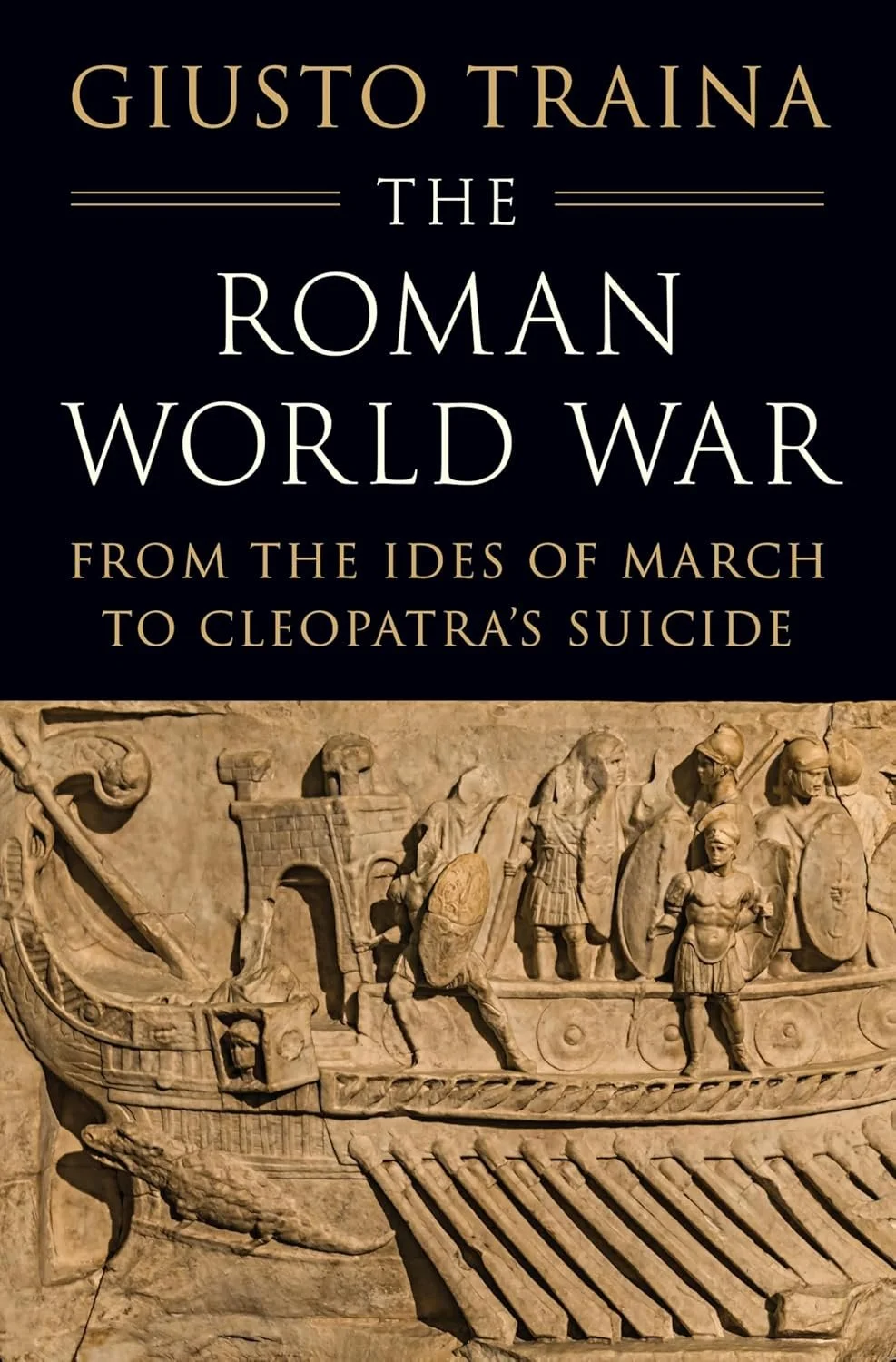
The Roman World War: From the Ides of March to Cleopatra’s Death
By Giusto Traina
Translated by Malcolm DeBevoise
Princeton University Press 2026
When what we would consider the year AD 30 was still new, Irish High King Fiacha Finnolach found himself facing one of the most well-organized conspiracies to usurp his admittedly tenuous rule. In Vietnam, the fierce Trung Sisters were continuing to mow down their opposition in a series of the well-orchestrated blitzkrieg campaigns. The efficient officials of the Han dynasty in China were dealing with both a large rebellion and a terrifying epidemic. Korea’s Yuri Isageum was enjoying the sixth year of his fat, contented reign by simplifying and clarifying legal codes and continuing, with gentle tact, to bring his aristocracy more and more under his control. And grandees and court historians of the Mayan civilization was looking back on nearly 2000 years of their own history.
All these people had plenty of things in common (halitosis, body lice, nighttime dreaming, etc.), including: not one of them, nor any of their many thousands of subjects, ever heard Rome or the Romans. All of them, without exception, would go to their graves without ever hearing the name Octavian. The 64 million square miles of the Pacific Ocean rolled on year after year, century after century, without ever knowing a Roman prow. The sky over what would much later become Russia was untroubled. The Arctic was empty of even the faintest hint of humans, much less the extreme specificity of a Marc Antony.
So the central contention of historian Giusto Traina’s The Roman World War (here translated by Malcolm DeBevoise), that the various hostilities that roiled the Roman world between the assassination of Julius Caesar in 44 BC to the death of Antony and Cleopatra in AD 30 constituted a world war is certainly false. “The events of the Late Republic cannot properly be characterized as a concatenation of civil wars, because their implications were worldwide,” Traino writes. “To speak of them in this manner may seem anachronistic, for the term ‘world war’ was not used before the nineteenth century; the ancients, however, had no trouble telling the difference between ordinary and extraordinary wars.” It’s true, the ancient historians could tell the difference between a war and a really big war. But the anachronism persists; they no more knew what a world war is than they knew what a GPS satellite is. When Traino defines a world war as “a mixture of foreign war and civil war,” he’s being willfully unhelpful. 4000 years ago, the kingdom in control of most of what is now Eritrea fought a foreign war with what is now Ethiopia while simultaneously fighting a civil war led by members of its military caste. Would Traina call this a world war?
Its silly nomenclature overreach aside, The Roman World War is a slim but very readable account of those aforementioned Roman civil wars between Octavian and Antony and Cleopatra, which Traino captures in all its see-sawing complexity:
After Brundisium, Octavian was obliged to turn his attention once more to Italy, stricken by war and famine. It was just then that the triumvirs set about restructuring the Senate, which had lost a good many members on account of the war and the proscription lists of 43. Citizens from the lower orders who could be counted on to support the triumviral claim to authority were elected by fiat, raising the number of senators to a thousand. Never in the whole of its history had the Senate been so overcrowded or so discredited, and yet for all that it did not cease to function as a deliberative body.
And the frequent gestures he makes in the direction of his pet recasting do in fact pay some modest dividends. This concatenation of civil wars did, after all, extend more widely than most casual readers of ancient history tend to remember. Traino is right, for instance, to remind such readers that in the week that Julius Caesar was assassinated, he was in the final stages of launching a military campaign deep into what is now Iran. This might not qualify as any kind of world war, but it certainly helps to make the very familiar story presented here feel fresh.
Steve Donoghue is a founding editor of Open Letters Monthly. His book criticism has appeared in The Washington Post, The American Conservative, The Spectator, The Wall Street Journal, The National, and the Daily Star. He has written regularly for The Boston Globe, the Vineyard Gazette, and the Christian Science Monitor and is the Books editor of Georgia’s Big Canoe News