Transcription by Ben Lerner
/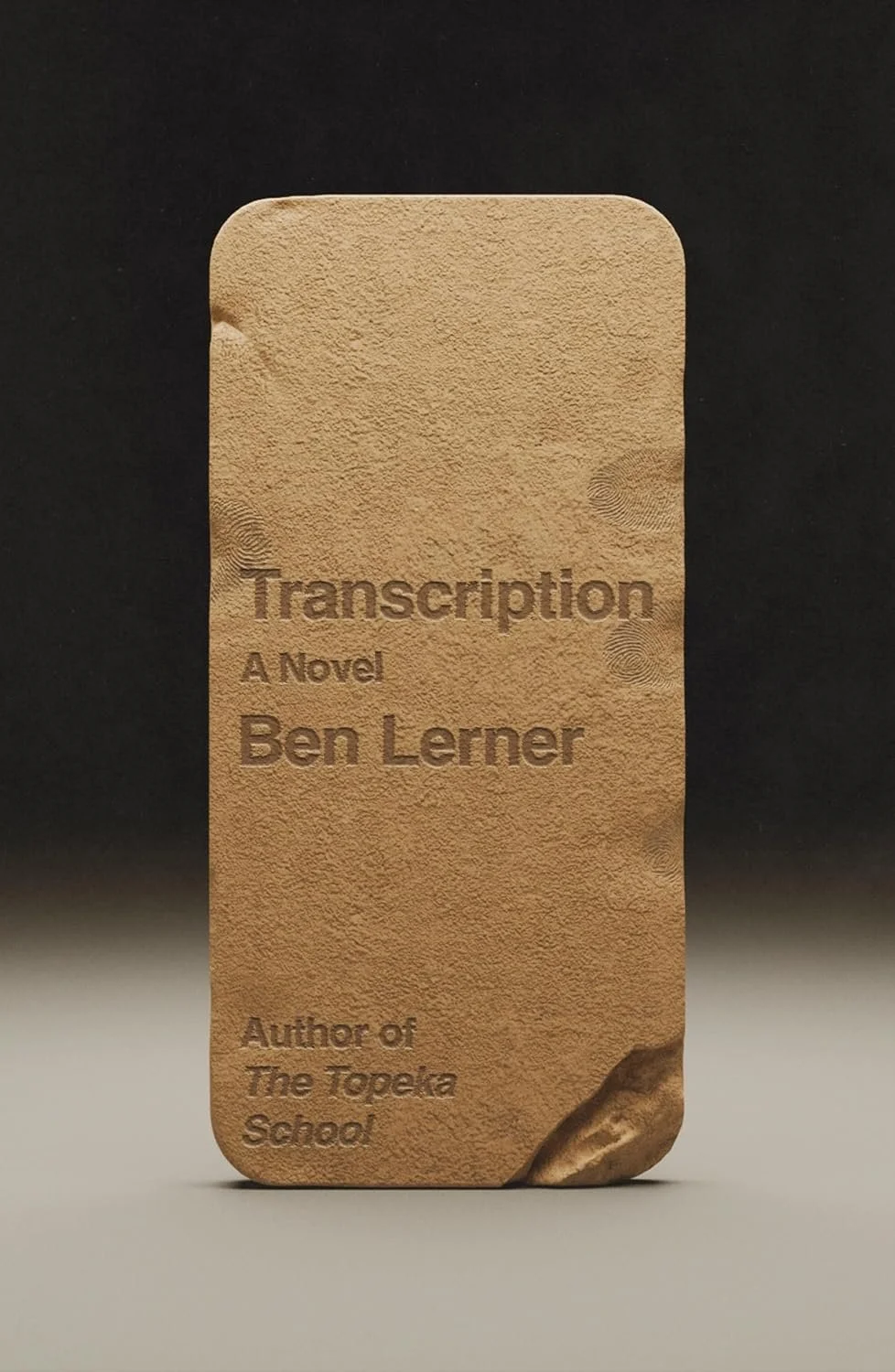
Transcription
By Ben Lerner
Farrar, Straus and Giroux, 2026
I’ve read library copies of Ben Lerner’s three previous novels—Leaving the Atocha Station, 10:04, and The Topeka School—with moderate interest in his personal psychological shavings and with only faint understanding of his current artistic prominence. But when I found out that his new novel, Transcription, was about interviewing a famous and difficult writer, I took the unusual measure of purchasing a copy. Primarily because I have done such interviews, but also because a critic I respect claimed that Transcription is a “brilliant attempt to resurrect the novel.” This turns out to be far from true, but Transcription is a funny and witty short fiction (130 pages) about three hypersensitive (and therefore unreliable) contemporary characters and one character from another time, the 90-year-old writer Thomas, who has almost no sensitivity to others.
Lerner is hardly the first to write the difficult-interview novel. There are Daniel Kehlmann’s Me and Kaminski, J. M. Coetzee’s Summertime, Don DeLillo’s Point Omega, and Philip Roth’s Exit Ghost, Probably the closest to Transcription is Point Omega, which isn’t funny at all but does have, like Lerner’s work, a famous bloviating elder and big thoughts about film.
Called a novel (and not a novella), Transcription is really three linked stories in different settings—Providence, Madrid, Los Angeles. One seems to occur before the pandemic and two not long after. In the first, a very nervous, phone-dependent, former research assistant to Thomas—a retired Brown University professor and world-renowned media theorist—travels to Providence to do the interview. The interviewer, who remains unnamed through all three stories, drops his phone in his hotel sink and thus deprives himself of a recording device. Nevertheless, he goes to the home of Thomas, doesn’t admit to having no workable phone, tries to delay the interview until the next day when the interviewer plans to buy a new phone, and finally pretends to be recording. Thomas refuses to delay and starts talking, first confusing the interviewer, then confusing facts of his own history, and eventually mistaking the interviewer for Thomas’ son, Max. Impatient with the interviewer’s stalling and deflecting, Thomas tells him what questions to ask. I had a tape snap in the middle of an interview one time, but Thomas is an interviewer’s nightmare, not an interlocutor who needs coaxing to talk but an interviewee who talks too much and with way too little coherence. And for Lerner’s bumbling interviewer there’s no tape to be wrangled into a useful or, at least, revealing transcription.
In the second story, the interviewer delivers a speech at a memorial symposium for Thomas in Madrid and admits to reconstructing part of the interview. After the speech and a lot of wine, the Spanish woman who organized the meeting attacks the interviewer in Spanish for not scrupulously recording the great man’s words and thereby interfering with his legacy. She mistakes talk about intellectual work for intellectual work. Like the dialogue of the interviewer and Thomas, this conversation is filled with linguistic misunderstandings—and there’s no recording or transcript to sort them out. A transcription, Lerner implies, is like a translation.
The first two stories are narrated by the interviewer. The final story, set in Los Angeles, has no narrator. It’s like a tape of a long mostly one-way conversation between Thomas’ son Max and the interviewer, both in their mid-forties, both late and anxious and self-conscious parents. Crazed by his daughter’s failure to eat and thrive, Max delivers a too-long monologue about the family’s difficulties that finally gets round to his account of speaking by telephone to Thomas on what Max thinks is his father’s deathbed from Covid. As Max remembers it, the call is full of his emotional provocations and contradictions. Then, in a fine comic reversal, Max discovers that his father recovers! Max can’t bring himself to repeat his sincere phone harangue—and there is no recording, no transcription. When Max braves Covid to visit his father in Providence and perhaps recover some of the conversation, the novel comes full circle, like circular logic.
Lerner’s triptych is unified by the interviewer, the influence of Thomas, and by repeated themes, particularly fatherhood, whether literal for the interviewer and Max or figurative for the Spanish acolyte. Doom oozes out from the failed interview to doomed legacy to literal doom in the pandemic. There’s the continuing irony of failed recording in the age of surveillance. The stories of Transcription can be called a novel because just about every fiction of any length is, metaphorically, a transcription of conceivably imagined conversations and possibly real thoughts in the novelist’s head. The novel has been so from Cervantes to Sterne to Beckett. Transcription may continue but hardly resurrects the novel, not in these 130 pages. Instead, Lerner plays with fictional form and with his postmodern characters’ anxieties about agency and truth.
Lerner is the author of three volumes of poetry. The model for Transcription is not ultimately fiction but modernist or contemporary poetry, variations on a theme, Stevens’ “The Man With a Blue Guitar” in three rather than 33 sections: “Things as they are/Are changed upon the blue guitar.” Although Lerner’s book is almost completely the “transcription” of often raw talk (“things as they are”), the text is like a delicate poetic composition, a carefully stacked game of color-coded Pick-Up Sticks. Extract one and the whole pile either changes or moves.
Lerner’s subtle cross-story allusions, repeated images, doubling names, and lying women are devices capable of uniting a non-narrative poem—and that are much overpraised by the aforementioned critic. These features can be found in the substantial fiction of another poet who became a novelist—Faulkner. But fancy fretwork is not why we read Faulkner, and the compositional intricacy that may help carry a book of 130 pages, such as Lerner’s, is not a method that will restore the supposed lost force of fiction.
“Supposed” because the novel needs no “resurrection.” The life of the novel as a form continues—not in Lerner’s clever wit and ingenious structure—but in the originality and relevance of the novel’s new information, the extra-literary knowledge that writers—such as Richard Powers, William Vollmann, Joshua Cohen, and Tom McCarthy—import into their stories to give them bulk and weight and intellectual efficacy lacking in Transcription.
Lerner’s autofictions always shade into metafiction, now more explicit in Transcription. The interviewer describes “how Thomas always talked, sudden changes of scale, rapid juxtapositions of images and registers.” Some of his skittering subjects are Schrödinger, lithium, World War II, psychoacoustics, radio, cave art, Plato, the healing properties of screens. Who or what might Thomas represent? Not, I think, the late Robert Coover, one of Lerner’s professors at Brown. No, I submit that Lerner’s Thomas recalls the almost-90 Thomas Pynchon, who influenced the four contemporary novelists I’ve mentioned above.
Lerner’s Thomas combines, like the Pynchon of his big books, information from a disparate array of sources, esoteric science and new media, pre-history and phantom voices beyond our ken. Pynchon’s best work has Lerner’s personal comedy but much more—planetary knowledge with deep cultural ramifications. In fifty years, if people are still reading fiction, it’s Lerner’s kind of work—personal, relatively superficial, sneakily elegant—that will need to be resurrected, not the kind of systems-conscious world-building done by Pynchon and his epigones.
Transcription is about “the anxiety of influence”—of Max’s literal father, the interviewer’s symbolic father. But deeper down, I think, Transcription is Lerner’s anxiety of not being influenced by a profound and dominating writer named Thomas, one who never thought 130 pages were a cultural contribution. Transcription is a minor response to major mastery—a kind of metafictional masochism if you need psychology. Or, of course, Thomas may not be a homage but a joke or insult. Things change on the blue guitar of art.
My Thomistic theory brings me to wonder: What if Thomas Pynchon decided to give his first and last interview, his final words before his passing? Though I sympathize with interviewers, I like to think the interview would be intentionally chaotic, a mockery of our need to have the artist speak to us in our impoverished, journalist-adjacent language. I further like to think that Lerner’s Thomas could be resisting his figurative children’s desire for some last summarizing and directing words, preferably spoken directly to each of them. One famous now-dead novelist I interviewed distrusted our spoken words and took a year to rewrite the transcription I sent him. I quit interviewing after another famous now-dead novelist refused to edit my transcription and refused to let me publish it unedited. He’s the writer who said in his first novel, “What's any artist, but the dregs of his work? the human shambles that follows it around.”
Tom LeClair, along with Larry McCaffery, conducted and edited the conversations in Anything Can Happen: Interviews with Contemporary American Novelists. LeClair now has a Substack called “Monsterpieces.”