Like a Cat Loves a Bird by James Bailey
/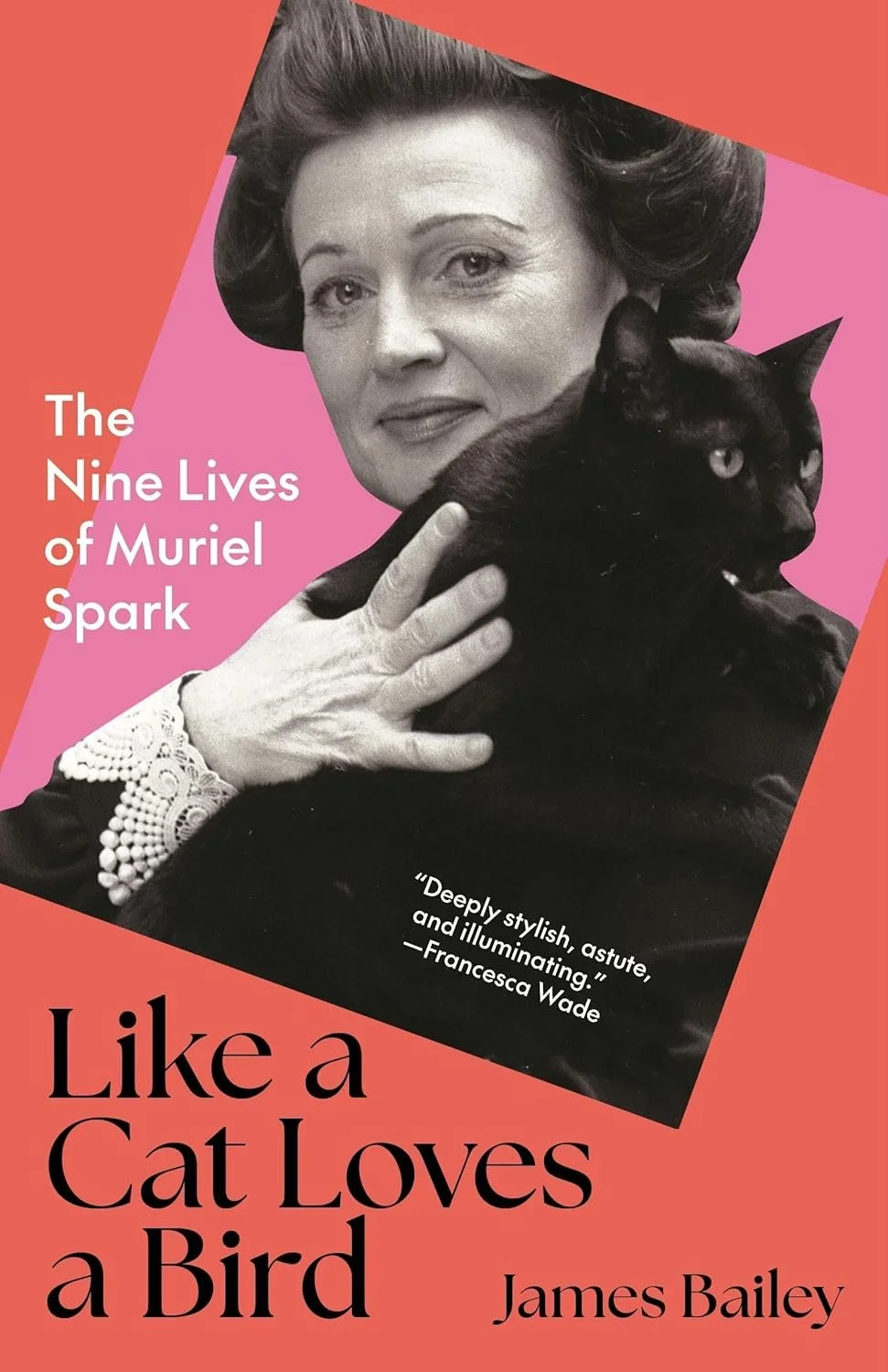
Like a Cat Loves a Bird: The Nine Lives of Muriel Spark
By James Bailey
Princeton University Press 2026
Like a Cat Loves a Bird: The Nine Lives of Muriel Spark, comes at the reader slightly aslant, stealthy in its insights, lightweight in page-count, playfully acerbic, overly fond of cats. It’s a smart, bantam weight (100 pages shorter than the next-shortest Spark biography, although still 100 pages longer than Spark’s own baffling memoir, Curriculum Vitae), savagely assessing, and ultimately memorable; in other words, young author James Bailey has written very first truly Sparkean biography of Muriel Spark.
The title derives from a comment of Spark’s about how she liked to torment the characters in her novels, and it strikes a cat-fancying note that sounds throughout the book just as it sounded throughout Spark’s life, particularly at the end in rural Tuscany when one of the 20th century’s finest writers became a reclusive cat lady (who was nevertheless writing and typing to the end). Bailey doubtless didn’t intend his book to be an ailurophobe’s nightmare, but the conceit proves surprisingly useful to him in telling the story of Spark’s “lifelong slipperiness” in both life and prose:
She toys with her characters, in other words. She stalks them across page after crisp, aloof prose. She makes sudden, decisive pounces, with brief flashes of violence: a burst of flames, a knife between the ribs, a beating in the dead of night.
Just when we think we have the measure of her, she slinks out of sight.
He loves her, this biographer who had to have been some kind of goofy teenager when his subject died in 2006, but it’s not a blind love. His discussions of Spark’s novels acknowledges their spare brilliance in more knowing terms than any previous critic but pays that brilliance the, again, Sparkean compliment of contrasting it with the rare misfires – ie, infamously, The Mandelbaum Gate:
It is a thoroughly strange novel. Not strange, that is, in the way of the novels which came before it, with their ghostly typewriters, supernatural telephone calls and ping-pong-playing cats. Its oddness lies instead in its unconventional shape and uneven tone … [it] lacks both the conceptual simplicity of the works that preceded it and the bleak, brittle quality of the novella-length fictions that followed in the years immediately afterwards.
He follows Spark through the various contrasting epochs of her life (all supported by very generous End Notes and a terrific bibliography), and because he’s less concerned with buttressing a ploddingly quotidian timeline than with following a supple essence through a dozen different incarnations, the uncontrived feeling of a life permeates emerges. His Spark is occasionally self-pitying, sometimes spoiled, always ruthlessly clear-eyed even when she’d prefer not to be, and, thanks to the focus of these brisk chapters, wholly a writer, a writer to the expense of literally everything else in her life. And the shifting focus of each chapter underscores one of Bailey’s touchstone sentiments: “there is always something else.”
“Just when I suspect I have the measure of her,” he writes, “she vanishes from view, before reinventing herself anew.” This presents him with an obvious problem, and, delightfully, his book’s fleet address of its subject’s decline and death is sparklingly indeterminate. “A book about Muriel Spark’s life, you see, has no business concluding with Muriel Spark’s death,” he writes. Shortly before her death, he notes, Spark had written five pages of a novel that will remain forever unfinished.
Like a Cat Loves a Bird is rather defiantly unlike all previous Muriel Spark biographies, and all of its differences are strengths. Even ailurophobes will rejoice in it, if grudgingly.
Steve Donoghue is a founding editor of Open Letters Monthly. His book criticism has appeared in The Washington Post, The American Conservative, The Spectator, The Wall Street Journal, The National, and the Daily Star. He has written regularly for The Boston Globe, the Vineyard Gazette, and the Christian Science Monitor and is the Books editor of Georgia’s Big Canoe News