The British Are Coming: The Graphic Edition Volume 1
/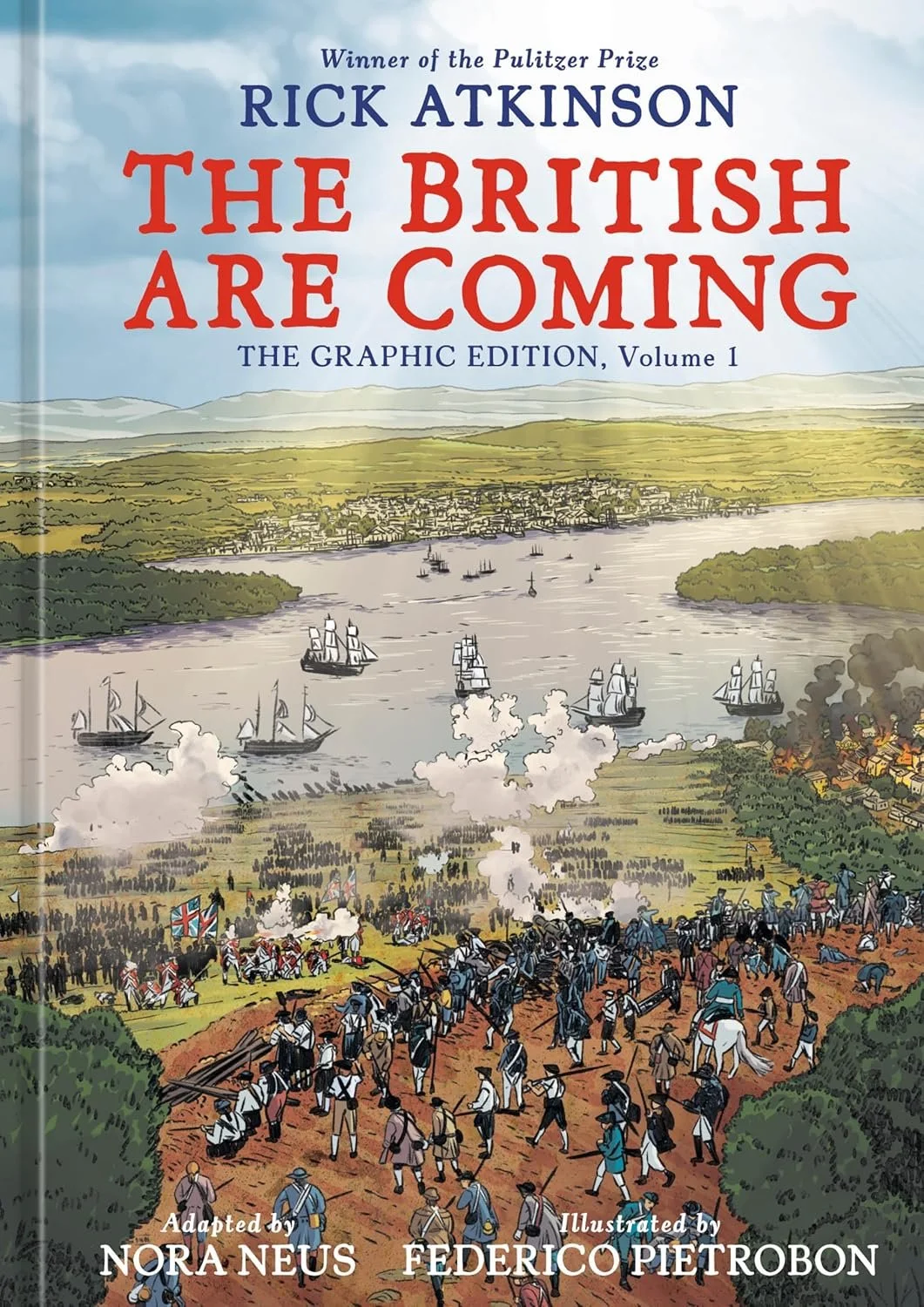
The British Are Coming: The Graphic Edition, Volume 1
By Rick Atkinson
Adapted by Nora Neus
Illustrated by Federico Pietrobon
Ten Speed Graphic 2026
The first volume of Rick Atkinson’s Revolution Trilogy, The British Are Coming, began his follow-up to his bestselling Liberation Trilogy about the US Army in World War II. As its title indicates, the Revolution Trilogy deals with the American Revolution, with the first volume covering everything from Lexington and Concord in 1775 to Washington’s Battle of Princeton in 1777. As with all of Atkinson’s other works of history, The British are Coming is both historically rigorous and narratively gripping, just exactly how popular history should be written.
Which makes this book, The British Are Coming, the Graphic Edition, Volume 1 all the more baffling. In these 250 full-color pages, the Revolution is dramatized in comic book format from the first murmurings of colonial unrest to Paul Revere’s famous ride (hence the slight misquote of the book’s title) to the explosion of violence at Lexington and Concord to the imposing, enduring, and lifting of the siege of Boston, with a significant detour to follow Benedict Arnold’s military expedition into Canada. The book ends with the British leaving Boston, just about the half-way point of Atkinson’s prose volume.
But Atkinson’s prose itself, by far the selling point of his books, is entirely missing from this “graphic edition,” as is virtually all prose of any kind. Instead, Nora Neus, who adapted it from Atkinson’s book, has chosen to carry on the bulk of the book’s narration through direct quotes from the many participants, from Boston townspeople to British generals to the King of England. Artist Federico Pietrobon does what he can to fill in the gaps this inevitably creates, but plenty of gaps still remain. Hence the bafflement: readers who aren’t familiar with the events being depicted here won’t always know what’s happening page-to-page, and readers who are familiar with the opening of the Revolution might be irritated by all the bad cinema jump-cutting.
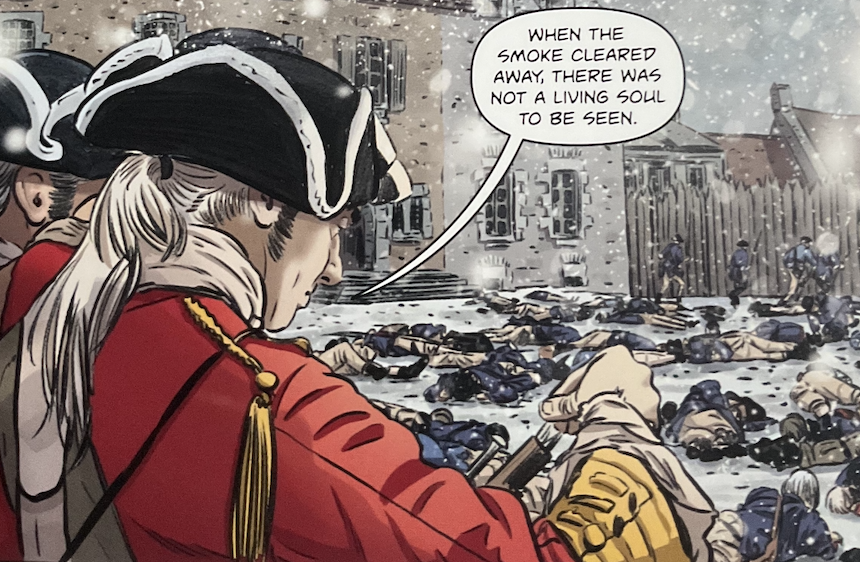
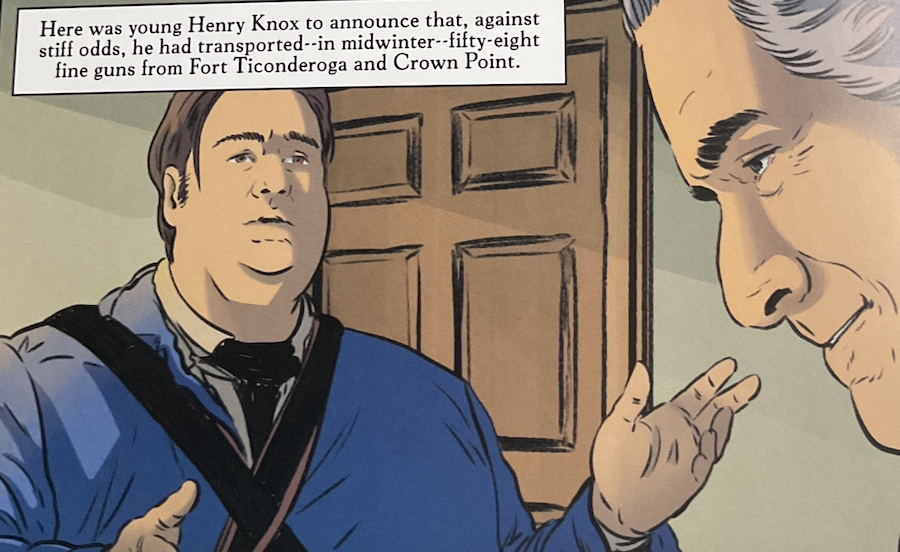
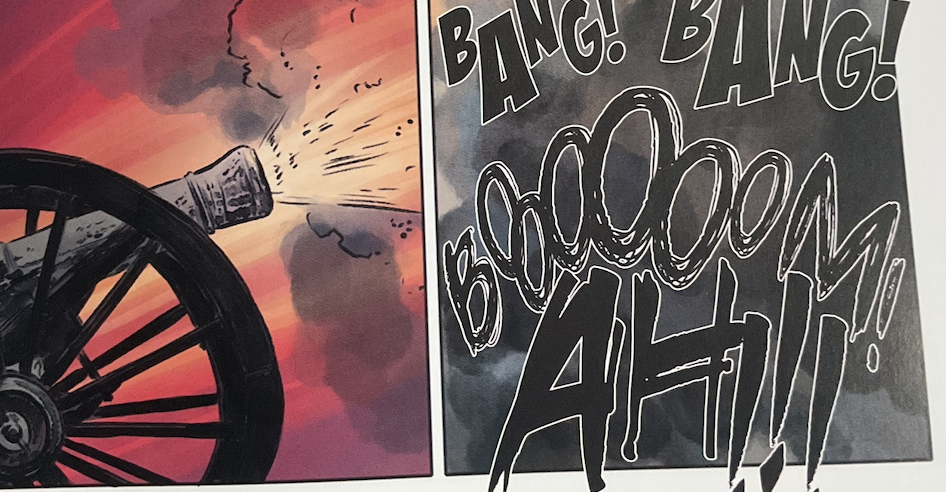
Pietrobon has a penchant for open spaces, which works well when reminding readers of just how rural 18th century New England was but confuses things when the Boston Massacre looks like it’s happening in Sherwood Forest. His recurring characters don’t have steady, fixed features, his established historical figures virtually never resemble their documented historical appearance, too many of his crowd scenes look like vague AI tracery, and he either exaggerates known physical features (as when Boston bookseller and Evacuation Day hero Henry Knox, known to be fat, is portrayed as something out of a circus freak show) or completely ignores them (Martha Washington, long-haired sex symbol). He provides just enough visual variety, ranging from military action scenes (in which all the guns go “Bang,” even though no gun ever has) to maps and diagrams showing troop strength and movement, to keep the visual end of the production afloat.
But the verbal end brings it down every time. The decision to produce virtually exclusively quotes from participants runs afoul of the obvious fact that people talk differently in the moment than they do in their memoirs or even their letters. By quoting instead of adapting to make people sound human, Neus often has characters speaking in the past tense about events that are happening to them right then on the page. “The whole line was one blaze!” shouts one soldier during the battle of Bunker Hill. “They fell in heaps, actually in heaps … the bodies lay very thick.” But a) the action is still happening while he says this, b) in the moment, he’d have sounded a lot more like something out of “Deadwood” than Shelby Foote in a Ken Burns documentary, and c) Pietrobon shows us no heaps.
At another point, a presumably seasick sailor leans over the rail and says, “I’m indifferent as to whether I live or die.” At another, an officer at Washington’s dinner table in Cambridge, sitting across from George and Martha, says aloud “They are very happy in each other” – a sentiment gleaned from a letter that would of course never have been uttered at the table in the moment.
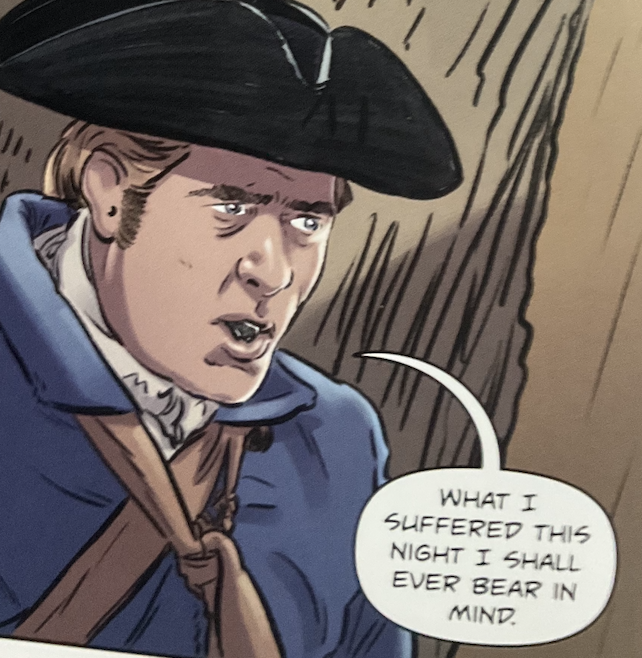
These weirdly stiff moments happen throughout, and they consistently raise the possibilities they squander: imagine Neus took the liberties allowed by the graphic novel format and let her people to talk with normal speech instead of quill pens. Even matched with Pietrobon’s somewhat static art, that might still have resulted in a truly memorable comic, something fit to stand alongside “March,” the graphic novel Andrew Aydin and Nate Powell made out of the life of civil rights icon Congressman John Lewis. As it is, the Revolution is a bit of a muddle. Maybe Volume 2 will have more focus of all kinds.
Steve Donoghue is a founding editor of Open Letters Monthly. His book criticism has appeared in The Washington Post, The American Conservative, The Spectator, The Wall Street Journal, The National, and the Daily Star. He has written regularly for The Boston Globe, the Vineyard Gazette, and the Christian Science Monitor and is the Books editor of Georgia’s Big Canoe News